Sign in. It’s quick, free and it’s up to you.
An account is an optional way to support the work we do. Find out more.
Sign in. It’s quick, free and it’s up to you.
An account is an optional way to support the work we do. Find out more.
LAST UPDATE | 27 Jan 2025
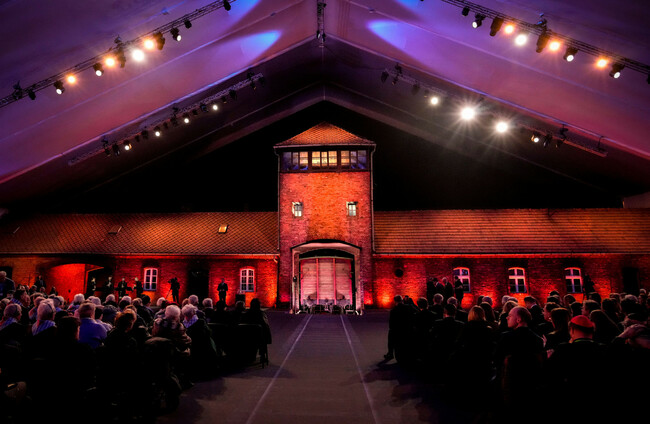
SOME OF THE few remaining survivors of Auschwitz returned to the notorious Nazi death camp today as the world marked the 80th anniversary of its liberation.
Auschwitz was the largest of the extermination camps and has become a symbol of Nazi Germany’s genocide of six million Jews, one million of whom died at the site between 1940 and 1945, along with more than 100,000 non-Jews.
Elderly former inmates, some wearing scarves in the blue-and-white stripes of their death camp uniforms, laid flowers at the site today, touching the camp’s Wall of Death in silence.
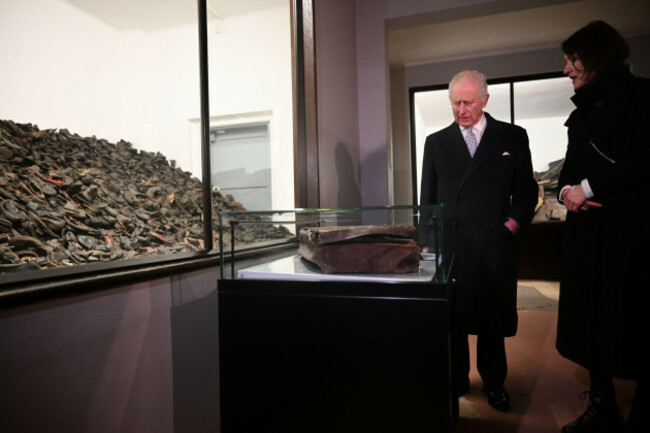
Some 50 survivors attended the main commemoration outside the gates of Auschwitz II-Birkenau. They were joined by dozens of leaders, including Taoiseach Micheál Martin, Britain’s King Charles III and French President Emmanuel Macron.
“Eighty years after liberation, the world is again in crisis,” warned Tova Friedman, 86, adding that “the rampant anti-Semitism that is spreading among the nations is shocking”.
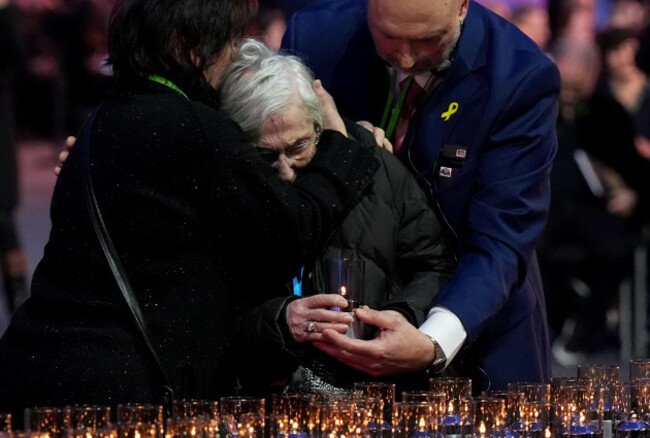
Along with Marian Turski, Janina Iwanska, and Leon Weintraub, Friedman was one of four former prisoners who spoke at the ceremony.
Earlier on Monday, elderly former inmates, some wearing scarves in the blue-and-white stripes of their death camp uniforms, laid flowers at the site, touching the camp’s Wall of Death in silence.
There were no speeches by politicians.
In an anniversary statement, Tánaiste Simon Harris said Ireland is committed to countering “all forms of antisemitism, racism and discrimination”.
“It is essential that we learn the lessons of the Holocaust and continue to uphold its terrible truth against those who deny it.
“At a time of a global rise in antisemitism, I am committed to working with my colleagues across Government, and with Ireland’s Jewish community, to give effect to the commitment in the Programme for Government regarding measures to counter antisemitism,” he said.
“It is everyone’s mission to do everything possible to prevent evil from winning.”
Speaking before today’s commemoration, Martin said it is an opportunity to “remember the unique horrors of the Holocaust, in particular the extermination of six million jews from across Europe in the Nazi death camps”.
He added that it is also an opportunity to “remember the Roma, the disabled, the political dissidents, the members of the LGBTQ community and all who were persecuted and murdered without mercy in the camps”.
Speaking to AFP ahead of the anniversary, survivors around the world spoke about the need to preserve the memory of what happened when there will no longer be living witnesses.
They also warned about rising hatred and anti-Semitism in many countries and spoke of their fears about history repeating itself.
Organisers said it could be the last major anniversary with such a large group of survivors.
“We all know that in 10 years it will not be possible to have a large group for the 90th anniversary,” Sawicki said.
Auschwitz was created in 1940 using barracks in Oswiecim, southern Poland. Its name was Germanised into Auschwitz by the Nazis.
The first 728 Polish political prisoners arrived on June 14 of that year.
On 17 January, 1945, as Soviet troops advanced, the SS forced 60,000 emaciated prisoners to walk west in what became known as the “Death March”.
From 21-26 January, the Germans blew up the Birkenau gas chambers and crematoria and withdrew as Soviet troops approached.
On 27 January, Soviet troops arrived, finding 7,000 survivors.
The day of its liberation has been designated by the United Nations as Holocaust Remembrance Day.
With reporting by AFP

To embed this post, copy the code below on your site






have your say