Sign in. It’s quick, free and it’s up to you.
An account is an optional way to support the work we do. Find out more.
Sign in. It’s quick, free and it’s up to you.
An account is an optional way to support the work we do. Find out more.
This is a mostly spoiler-free review but does contain details from the film. If you want to go in knowing nothing then do not read this review. You have been fairly warned.
THIS IS NOT a documentary about Theranos.
You Can See Everything, the new film by Nathan Fielder and Lance Oppenheim, is instead a three-hour masterpiece that explores whether it’s possible to separate a human being from their reputation as a master manipulator and fraud extraordinaire when they are adamant that they are telling the truth.
And Elizabeth Holmes is adamant.
Holmes and her husband Billy Evans (we will get back to Billy Evans) granted Fielder total access to their home and shared life for the 34 days that led up to Holmes’ sentencing hearing in 2023. Holmes was eventually sentenced to over 11 years in prison, where she remains, and was ordered to pay $452 million in restitution to her victims, which encompasses patients and investors.
From the outset, Fielder skulks and prowls about their home, recording their conversations and probing their personalities, in an attempt to establish whether Holmes can possibly believe she was telling the truth when she promised her Theranos technology could run every possible medical test needed based on a single drop of blood.
These days, a story like this would typically be told over the course of a six-part series on a streaming service. Every conversation Fielder has with Holmes or Evans seems to end on a cliffhanger, not least because Fielder employs his idiosyncratic style of leaning into ambiguity wherever he finds it, picking up on awkward sentences that are left hanging, shamelessly asking after the feelings and thought processes that underpin everything that Holmes’ tells him.
When Fielder challenges Holmes early on in the documentary about the significant evidence that she committed fraud, she breaks the conversation when she starts to cry. When he grills her later on her claim that she has never knowingly told a lie, she interrupts it to focus on her child.
Holmes speaks in riddly phrases, saying things like “I feel like I know I was trying to” communicate honestly. It immediately feeds into the consensus about the woman who was once marketed as ‘the female Steve Jobs’ as someone who either refuses to or is unable to engage with the dishonesty at the heart of her story.
It is striking, therefore, that the documentary succeeds in creating a sense of genuine empathy for Holmes. As Fielder spends more and more time with Holmes, he creates a sense of genuine empathy for the 42-year-old, who has a young child and a baby at the start of the documentary.
This sympathy comes in large part from her relationship to Evans, a man 10-year her junior whose control over Holmes is evident in almost every interaction. In one especially telling scene, Evans seizes a mixing bowl and whisk out of Holmes’ hands as she’s using it because he does not believe she is whisking her eggs properly. When Fielder asks him why he did, he says it’s so Holmes can focus on speaking to the documentarian, even though it was Evans who had been speaking the entire time.
The final third of the documentary, filmed after Holmes was sentenced, is a stark tonal shift that ratchets up the questions over Evans’ level of control in Holmes’ life, with more than a little help from a very famous actress whose presence in the documentary adds a wonderful additional quirk to proceedings.
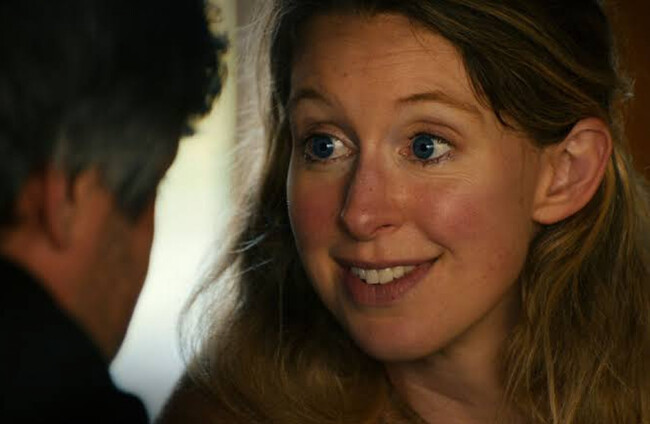
Throughout, Holmes is wide-eyed, open, trusting in Fielder to a degree that is almost uncanny. She behaves like a woman who has absolutely nothing to hide, a mother who loves her children, a wife who adores her intense and oftentimes scary husband, and a person who has experienced stark and painful consequences for her actions without seeming to understand why.
The intention of the documentary is not to engage with the case against Holmes, whether the science behind Theranos was honest, and whether what Holmes did was right or wrong. Instead, it’s a self-contained study of a woman who, at best, seems to be in need of some degree of protection from the world around her.
The result is a very real statement about the current climate that exists around modern technology, investment in that technology, and the kind of personalities who successfully position themselves in roles where immense wealth and power are concentrated.
Whether one comes out of the documentary feeling sympathy for Holmes — and many, many will — one conclusion is clear. Silicon Valley has a profound problem when it comes to trusting people who cannot prove their trustworthiness. Indeed, given the proliferation of oligarchic tech CEO figures who oversee unimaginable financial and technological power, it’s a documentary that gets right at the heart of a question that should trouble us all. Who are these people at the avant-garde of tech and money? How do they think, and can they be trusted to communicate honestly with the rest of the world?
The documentary delivers on its premise. You can, indeed, see everything. But seeing is very different to knowing, and maybe that’s the whole point.

To embed this post, copy the code below on your site













have your say