Sign in. It’s quick, free and it’s up to you.
An account is an optional way to support the work we do. Find out more.
Sign in. It’s quick, free and it’s up to you.
An account is an optional way to support the work we do. Find out more.

AS CIVIL SERVANTS prepare for strike action next week, public service military representatives have said their inability to take industrial action has caused Defence Forces personnel to leave the forces.
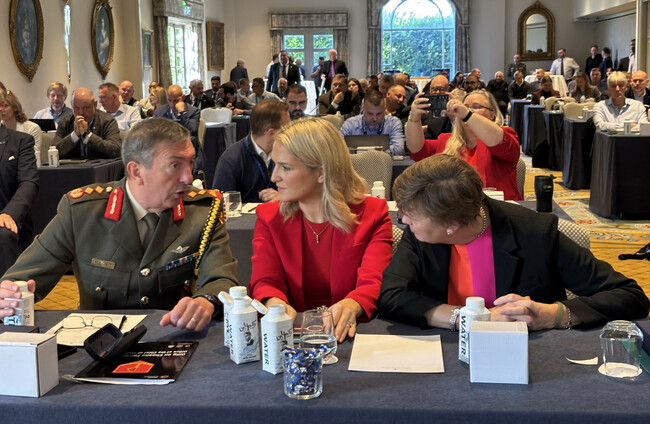
Euromil, the European wide body that represents military personnel, held its General Assembly in Naas today.
Minister for Defence Helen McEntee and Chief of Staff Lieutenant General Rossa Mulcahy spoke to delegates from across the European Union and Ukraine.
Speaking at the event, members of officers’ group RACO and enlisted ranks PDFORRA said their basic employment rights are undermined.
Conor King, general secretary of RACO, said that there is an ongoing problem of basic industrial relations mechanisms that do not function in Ireland.
One key aspect is that the post of adjudicator, an official that acts as a mediator in disputes between the State and the representative associations, has not been filled.
“Of course, the key piece that’s missing is a robust and well-resourced industrial relations framework, which is our conciliation and arbitration scheme. At the moment, we do not have an adjudicator. We haven’t had one for 15 months,” he said.
He said this was an “extremely poor look for the government” and prevents military personnel exercising “our rights in relation to the consultation and negotiation space”.
King believes that the refusal to engage by the government on the payment of overtime to military members is causing people to leave.
“The fact that they have refused to speak to us or negotiate on overtime rates just shows that while they accepted the recommendation of the Commission on the Defence Forces [report], they really didn’t have any intent to engage fully with them, and that is a barrier to retention because eventually people realise that they’re not actually valued,” he said.
PDFORRA, which represents the rank and file members of the Army, Naval Service and Air Corps, shares the same issues. They are currently in the midst of a legal battle centred around the lack of an adjudicator.
Araon Kearney, President of PDFORRA, said he could not speak about the adjudicator issue but added that his group has decided that consistent court cases here in Ireland and in Europe are the solution.
“When you look at the cases that we’ve taken against the government in the last couple of years – that’s our avenue to get things dealt with,” he said.
Kearney said that his members are watching repeated announcements of new equipment and workplace conditions measures, but there are little real world signs of anything changing.
“I suppose the frustration for our members is when policies have been announced on numerous occasions and nothing has been fulfilled.
“There is a constant rehashing of policies that are going to be rolled out, and we’ve yet to see anything come to fruition,” he added.
Martin Ryan, President of RACO, said that he is coming across the same frustrations in the officer ranks.
He said that the adoption by the Defence Forces of the Working Time Act, in which the working day for soldiers, aircrew and sailors are recorded, has been a victory for the associations, but that has not resulted in actual meaningful change in conditions for personnel.
Ryan said he believes this is being done to avoid difficult questions being asked about the pay of military members.
“We still don’t have a defined working day, working week. There are very few employees in this country that don’t know what their working day is in terms of hours.
“We would very much feel that the reason that things like this are not defined is because it does lead then to a question regarding premium payments or overtime payments that are in line with hourly rates of pay, as opposed to duty payments at the moment, which equate to remuneration that is well under the minimum wage,” he added.
Ryan said that this is causing significant recruitment and retention of staff problems.
Helen McEntee defended the government’s handling of the concerns of military personnel. She said that their inability to take strike action does not limit their negotiations for better pay and conditions.
“Absolutely not and if anything, it just highlights, and has me more aware and conscious of the fact that we need to listen, and we need to be engaging, where they can’t engage in that industrial action.
“That we are at the same time listening to what they are saying to us as well, but that they still have those channels through the wider discussions that are happening with colleagues and DPER [Department of Public Expenditure] as well.
“I think for me it doesn’t diminish it at all. It actually just makes me even more aware that we need to continue our engagement and that we need to support them,” she said.

To embed this post, copy the code below on your site















have your say