Sign in. It’s quick, free and it’s up to you.
An account is an optional way to support the work we do. Find out more.
Sign in. It’s quick, free and it’s up to you.
An account is an optional way to support the work we do. Find out more.
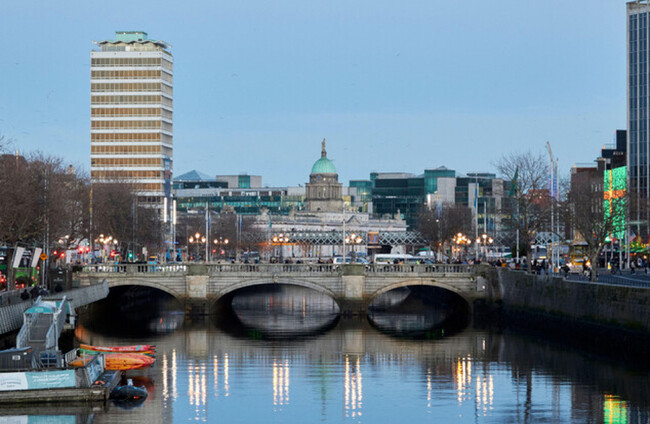
DUBLIN CITY COUNCIL will have a budget of €1.85 billion in 2027, an increase of €150 million on this year.
The draft budget will be presented to councillors at City Hall this evening by chief executive Richard Shakespeare, where they will decide whether to adopt it as it is or propose amendments.
The local authority’s budget is made up of government grants, local property tax and the provision of council services and commercial rates.
The €1.85 billion will be split between eight separate services.
The majority of it – €975.2 million – will be spent on housing and building. This includes maintenance and proving existing units, community development support and the HAP programme.
The cost of providing homeless services takes up the largest portion of the housing budget and is continuing to grow. In 2022, the figure stood at €194.1 million. Next year, it is estimated that it will cost €431.5 million, up 25% on 2026.
In the report, Shakespeare said this cost continues to rise “due to the persistent drivers of homelessness and the ongoing shortage of social and affordable housing options for rent and purchase across the city”.
The number of people recorded as homeless in emergency accommodation in Ireland breached the 18,000 mark in September. More than 70% of the adults using emergency accommodation are in Dublin.
Homeless services in the city are managed by the Dublin Region Homeless Executive (DRHE) on behalf of the four Dublin local authorities. These authorities can recoup up to 90% of expenditure from the Department of Housing, but they must fund the balance themselves.
Shakespeare said the council and the DRHE have “consistently highlighted the issue of increasing homeless service costs” with the Department of Housing and have sought additional State funding to support the delivery of the service.
The DRHE submitted a business case to the department last year seeking agreement “on a more sustainable, long-term funding model for homeless services”. But Shakespeare said that the department confirmed to the council this year “that State funding would remain capped at 90% of eligible expenditure”.
He said the council plays a central role in addressing homelessness through the delivery of social and affordable housing, but “many of the underlying drivers of homelessness remain outside the Council’s direct control.”
He said the principal driver of family homelessness continues to be notices of termination issued within the private rental sector, while the principal driver of single-adult homelessness is “the discharge of individuals with Leave to Remain or refugee status from Direct Provision accommodation without access to suitable housing options”.
Some €167 million has been allocated for road transport and safety, including maintaining and improving local and regional roads, public lighting, car parking and promoting road safety education.
Water services take up €39.6 million of the total budget. This includes €26.5 million for local authority water and sanitary services, €5.5 million for water supply and €2.2 million for waste water treatment.
Development management refers to the council assessing development proposals and planning policies and objectives. Heritage and conservation services also fall under this category. The total budget allocated to development management is €114.5 million.
For environmental services, such as operating landfill, recovery and recycling facilities, waste collection services, litter management, street cleaning and the operation of the fire service, the budget is €250.2 million.
The budget for street cleaning services has increased from €66.9 million this year to €69.8 million in 2027.
Shakespeare said the increased budget will allow for additional waste collection services through more vehicles and the deployment of more ‘big belly’ bins, which are solar-powered and hold up to five times the waste volume of traditional bins.
The budget for the operation of the fire and ambulance service has increased from €107.6 million to €116.8 million.
Shakespeare said the council has sought funding from the HSE towards the cost of the service, adding that the “inadequate level of funding provided has been an ongoing source of dispute” between the Dublin local authorities and the health service.
“Although Dublin Fire Brigade has been providing an emergency ambulance service for the people of Dublin since as far back as 1898, it is under no statutory obligation to do so,” he said.
As part of a review in 2014, the cost of providing Dublin Fire Brigade’s emergency management system to the HSE was found to be €18.59 million.
“The HSE has acknowledged and paid just €9.18 million of these costs on an annual basis,” Shakespeare said, adding that €9.41 million has not been paid and resources were diverted by the Dublin local authorities to fund the service.
He said the cost of the emergency management system was estimated at €29.7 million in 2025, including the cost of a paramedic vehicle and two additional ambulances.
Shakespeare said there has been “significant engagement” between the departments of health and housing, the respective ministers, the HSE and the council over the last two years to secure additional funding for the ambulance service.
This has resulted in an agreement being reached which will see the funding of the ambulance service increase from €9.18 million to €18 million.
The recreation and amenity budget has been set as €157.9 million. This covers the operation of parks, pitches, playgrounds, swimming pools, libraries and archive services, as well as running arts programmes and allocating sports grants.
The report states that the budget for events has been increased by 25% from €8.6 million to €10.6 million.
Shakespeare said this reflects the council’s “continued commitment to celebrating the city’s culture, heritage and communities while supporting tourism, economic activity and civic participation”.
The report stated the events unit work on “shaping engaging events that animate the city, increase the numbers of people participating in major sporting and cultural events that are designed to be inclusive and to reflect the unique qualities of our capital city”.
It added that family-themed events like Dublin City Council Sensoria, the Luke Kelly Festival, the Liffey Festival and Twinkle Town “create valuable and inclusive experiences for locals and visitors alike”.
Some €5.2 million has been allocated for agriculture, food and the marine, which includes the enforcement of licensing of dogs and horses, as well as the Urban School Meals Scheme, the Cooked (Cold Soup) Scheme and the Hot Meals Scheme.
The report said there are currently 177 national schools in the three schemes.
The Urban School Meals Scheme catered for around 15,300 pupils daily this year, while the Soup Scheme catered for 100 pupils in two national schools.
Under the Hot Meals Scheme, a subsidy of €1.27 per pupil was paid towards the cost of providing hot meals in three national schools, where approximately 150 pupils received a hot meal on school days in 2026.
The total cost of operating the Urban School Meals and the Soup Scheme this year was €1.3 million, of which 50% was recouped from the Department of Social Protection.
The remaining €139.9 million will go towards miscellaneous services. This includes the operation of markets, motor taxation and malicious damage.
Ahead of the council meeting this evening, two parties – Sinn Féin and People Before Profit – have already proposed amendments to the budget. Both of these are related to rent increases for council homes, which were approved in the 2026 budget.
Sinn Féin has said its amendment would reverse the rent hikes, increase street cleaning and build more playgrounds across Dublin city.
The party’s group leader Daithí Doolan said increasing rates for commercial tenants by 11% would provide an extra €33.5 million in funding.
Doolan said €30 million can be used to reverse the rent hikes, with €2.5 million for cleansing and over €1 million for playgrounds.
“I would strongly encourage councillors from all political parties to put the people of Dublin first and support our budget proposal at Monday night’s council budget meeting,” he said.
Meanwhile, People Before Profit councillors Conor Reddy and Hazel de Nortúin said their amendment would reverse the rent increases by raising revenue through commercial rates.
However, they also proposed a business support grant scheme to protect smaller ratepayers, adding that only the largest 3.1% of ratepayers would pay the full increase.
The party said they would also increase general housing maintenance funding by €2.5 million and restore €556,900 that has been cut from the Traveller accommodation maintenance budget.
“Traveller families are living with severe overcrowding and terrible conditions in some homes. Reducing their maintenance budget in those circumstances is ludicrous,” de Nortúin said.
“That is why we have included provision to retain the Traveller accommodation maintenance budget, alongside an additional €2.54 million for general housing maintenance. We can fund both fairly while reversing these unjust rent increases.”

To embed this post, copy the code below on your site









have your say