Sign in. It’s quick, free and it’s up to you.
An account is an optional way to support the work we do. Find out more.
Sign in. It’s quick, free and it’s up to you.
An account is an optional way to support the work we do. Find out more.
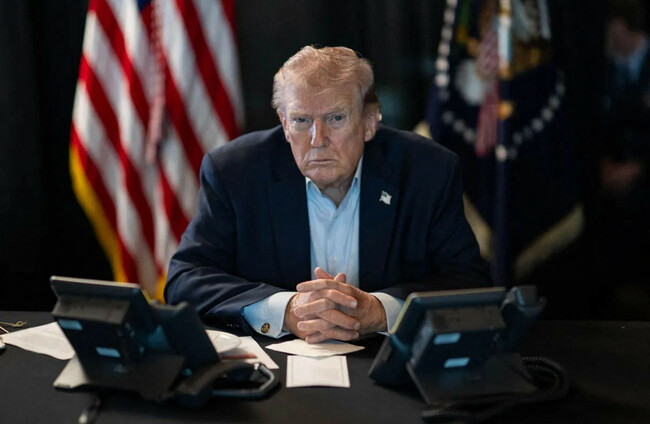
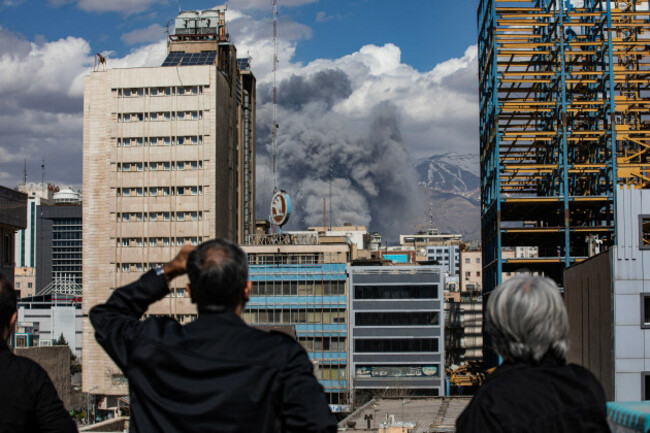
IT’S BEEN ONE week since the United States and Israel launched a war of choice against Iran and the Trump administration has offered a variety of reasons and justifications for the attack in that time.
Depending on which American official is speaking, the aim of the war is to topple the government of the Islamic Republic; destroy Iran’s nuclear facilities (something the US and Israel have already claimed they accomplished last year); eliminate Iran’s proxy forces in the Middle East; and destroy the country’s military capacity wholesale.
And all of this is supposed to happen in the space of four to five weeks, according to President Donald Trump, who has since changed the timeline and suggested the US could continue the fight “forever”.
Similarly, the justifications put forward by the Trump administration have been fluid and subject to change depending on who is speaking to the media on a given day.
US defence secretary Pete Hegseth and press secretary Karoline Leavitt have pointed to Iran’s targeting of US military bases and personnel through proxy forces in the Middle East for decades, while secretary of state Marco Rubio said Saturday’s attack was launched because Israel was going ahead with its own assault and the US needed to act pre-emptively to scupper attacks on American bases and allies in the Persian Gulf.
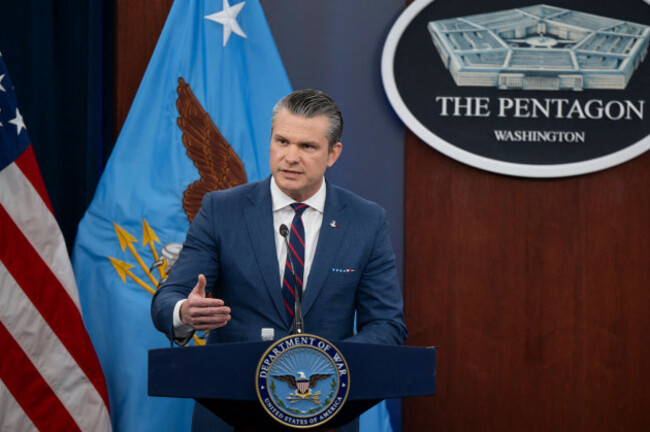
Trump has since contradicted Rubio’s version of events, saying he had “forced” Israel’s hand.
The mixed messages about the US war objectives and justifications have made it difficult to ascertain what a victory would look like, at least from an American perspective.
In an effort to speculate on what ends the bloodshed and brings the war to a close, whenever that may be, The Journal asked a number of experts. Here’s what they said.
Illegal
First and foremost, “The invasion is illegal, plainly contravening international law,” according to DCU’s Donnacha Ó Beacháin, professor of politics at the university’s School of Law and Government.
“As for war aims, there has been little consistency from the US administration,” he said.
“Trump initially signalled that he sought regime change on the cheap: the US would bomb Iran and give ‘the people’ a once-in-a-lifetime opportunity to overthrow the government themselves. Crucially, there would be no US boots on the ground.”
This framing, Ó Beacháin said, would absolve the US of any responsibility if the collapse of the Islamic Republic government does not come to pass, putting the blame instead on the people of Iran.
“It has been difficult to ascertain what the precise US objectives are in Iran,” so says UCC professor of modern history David Ryan, who also pointed to the multiple aims stated by different US officials.
He said that Rubio’s account of events, whereby the US acted in response to Israel, “was a surprising argument because implicitly it suggested Israel was in the driving seat as far as decisions were concerned”.
“Indeed, Trump contradicted it quickly,” he said.
Jeremy Maxwell, an American assistant professor and military historian at Maynooth University, similarly said there has been no “clear indication of what the actual war aims are”, especially because “to date there’s been no real presentation of an inherent leader that would step up in Iran”.
Trump has said that the abduction of Venezuela’s president, Nicolás Maduro, is the model for his intentions with the Iranian government. The US has maintained relations with Maduro’s government since removing him, dealing with acting president Delcy Rodríguez.
“Venezuela was so incredible because we did the attack, and we kept government totally intact. And we have Delcy, who’s been very good.
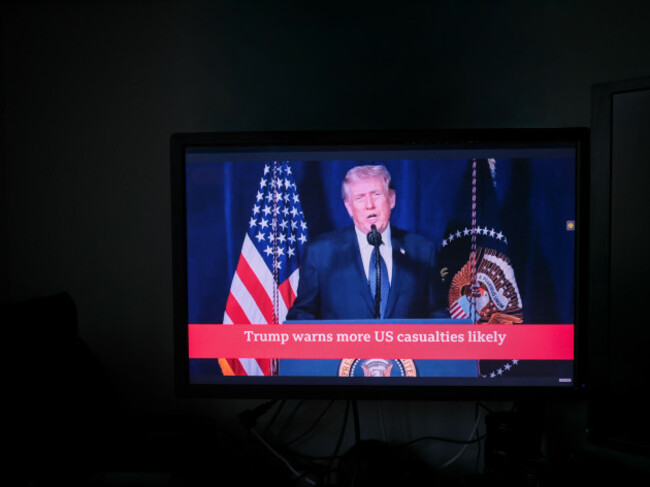
The initial attack last Saturday killed Iran’s supreme leader, Ayatollah Ali Khamenei, and Trump has since said the US should be “involved” in choosing the country’s future leader.
The Iranian government has since insisted it will not negotiate with the US.
“I guess the worst case would be we do this, and then somebody takes over who’s as bad as the previous person, right? That could happen. We don’t want that to happen,” Trump said this week.
“It would probably be the worst. You go through this and then, in five years, you realise you put somebody in who is no better.”
As for an Iranian version of Rodríguez, “Most of the people we had in mind are dead,” Trump said.
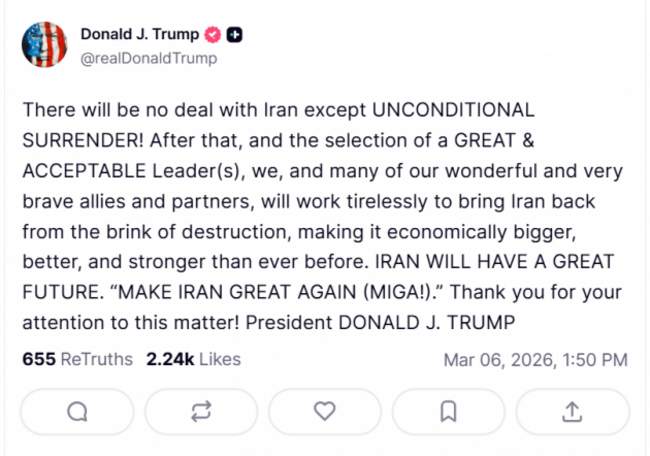
Regime change
The term “regime change” carries a lot of baggage in US politics, after the invasion of Iraq in 2003 that toppled Saddam Hussein.
Yet that appears to be the plan this time as well, except the US government just doesn’t like to call it that.
Secretary Hegseth made a telling comment to that end on Monday.
“This is not a so-called regime change war,” he said. “But the regime sure did change, and the world is better off for it.”
Ó Beacháin said: “It is unclear what successful precedent the current US administration believes it is drawing upon, or how it expects such a strategy to succeed under contemporary conditions.”
Maxwell said that a military victory will not be achieved through aerial attacks alone, even though Iran is outmatched in that regard when compared to the US.
“From a military history standpoint, there’s been many people that wanted short wars,” he said, but that “very rarely ever happened.”
“All of the military efforts to date, as in airstrikes, would assume that the American public does not want casualties. It hasn’t in the modern period,” Maxwell said, adding that it seems “they’re going to try and do everything with air assets”.
Airstrikes can be effective, he said, but “if the goal is to start a war and win a war, you’re not going to do that without boots on the ground. It just has never happened.”
But Ryan said the prospect of sending troops into Iran “would surely induce domestic resistance after Iraq and Afghanistan”.
As for what success would look like for Iran? The Iranian strategy will be to drag out the conflict and hope that allies of the US in the Gulf, who have borne the brunt of Iran’s retaliation, will pressure Trump into relenting, Maxwell said.
“Ultimately, ‘winning’ is in the eye of the beholder,” Ó Beacháin said.
“For the Iranian regime, simple survival against a materially superior adversary – albeit one that avoids deploying ground forces – could be framed as victory.
He said Iran’s ability “to impose costs, whether through missile strikes on US allies or spikes in global energy prices, could be presented by Tehran as strategically advantageous. But regime continuity is the core objective.
“For Trump, the definition of American victory will be politically constructed.”

To embed this post, copy the code below on your site












have your say