Sign in. It’s quick, free and it’s up to you.
An account is an optional way to support the work we do. Find out more.
Sign in. It’s quick, free and it’s up to you.
An account is an optional way to support the work we do. Find out more.
LAST UPDATE | 7 Jul
SINN FÉIN’S MARY Lou McDonald has said it would be “kind of astonishing” if Fianna Fáil voted against its proposed legislation aimed at actively preparing for a referendum on Irish unity on the island of Ireland.
Sinn Féin’s Planning for Constitutional Change Bill calls on the government to draft a Green Paper within 18 months and following that, to establish a Citizens’ Assembly.
If passed, the party says it would represent a significant step forward towards planning for a united Ireland.
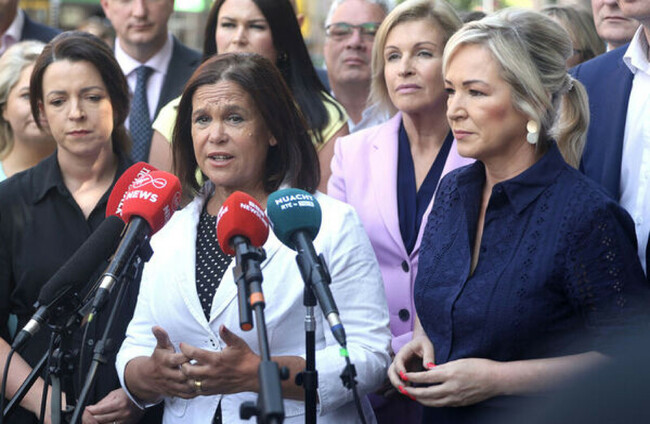
McDonald, who was joined by First Minister Michelle O’Neill outside Leinster House today, said this is not about Sinn Féin, but is a matter for all citizens.
McDonald said bringing the legislation was both an “important milestone”, and called on Fine Gael and Fianna Fáil to support the legislation.
She said it was a common sense approach to plan for a referendum, whenever it might be called, stating it was “dangerous” not to plan ahead.
McDonald said this is a “political test” for those parties who say they are in favour of a united Ireland.
Fine Gael’s Simon Harris recently announced that his party are also taking steps towards preparation, announcing that Fine Gael will develop a “blueprint for a unified island” by November.
McDonald said it was a “significant move” and one she welcomed.
She called on Fianna Fáil to do the same, stating that a number of TDs in the party are understood to be supportive of her bill, with some calling for a free vote on the opposition party’s bill.
A briefing on the proposed legislation was attended by politicians such as Senator Tom Clonan, Frances Black, and Fianna Fáil TD Pat ‘the Cope’ Gallagher.
Gallagher said he was speaking on a personal capacity and did not know yet what way his party might go on the issue.
Gallagher said he had not been “told officially what we’re doing”, but said he would support the bill if he was to be given a free vote.
He added: “I would be anxious that we could move forward, that this vote would be carried. I’m not so sure what might happen.
“I haven’t been told officially what we’re doing, but I’ve been loyal since I came in here in 1981 and I’m hardly going to change now – but I will try and use my influence to ensure that we could move on with the green paper within 18 months or 24 months or whatever it may be.”
He said “a lot” of his colleagues would feel the same way, but added: “I’m waiting to hear the statement by the leader of my party, what the views are there, and we’ll wait and see what happens.”
Gallagher said he would “use his influence” within the party to garner support for the bill.
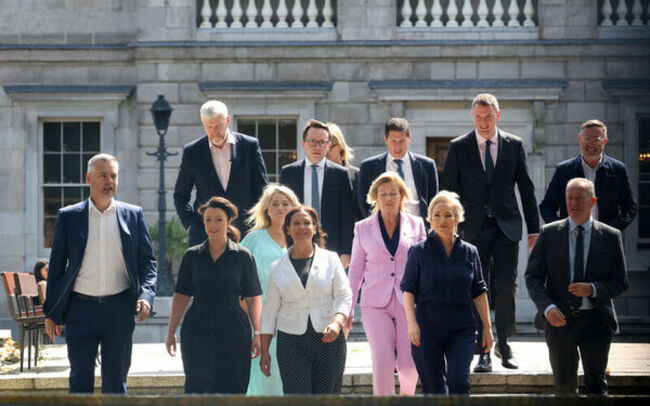
McDonald welcomed his comments, adding that it would be irresponsible for anybody in political leadership to bury their head in the sand and to imagine that they can simply wish away the facts of political, demographic and social change that is happening.
“There will be a referendum. Our objective is to secure that by the year 2030, but the referendums will happen, and the preparations need to be made now,” she said.
Sinn Féin deputy leader and O’Neill said a vote against the legislation would send a “really negative message” to those in the region and “really set back the project of our nationhood”.
The Good Friday Agreement states that the Secretary of State for Northern Ireland shall call a poll on unity if at any time it appears likely that a majority of those voting would support it.
Sinn Féin says that the responsibility rests “on paper” with the Secretary, but sits with the prime minister “in reality”.
Aontú leader Peadar Tóibín said he believes a united Ireland would cost in the region of €3-4 billion per year “in the first number of years” if re-unification takes place.
Meanwhile, Sinn Féin’s Pearse Doherty said a united Ireland could cost around €2 billion per year, but would fall off as economic growth took hold in the north.
A position on the proposed legislation is still to be agreed by cabinet, however, it is understood the Taoiseach, Tánaiste and the minister for foreign affairs will request the government agrees to oppose the bill.
The rationale put forward is that the government’s policy on Northern Ireland has focused on, supporting the operation of the Good Friday Agreement’s institutions; implementation of the Shared Island Initiative; addressing legacy of the Troubles; and promoting reconciliation.
A government spokesperson said that while the government is committed to a united Ireland what is proposed by Sinn Féin is not the correct approach.
They said legislation is not needed for a Green paper or Citizens’ Assembly and the government does not believe it is practical or fair to impose legislative timelines on this work.
Given the timelines contained in the bill, something which McDonald said she is opening to amending if needed, it is the government’s view that the bill is overly prescriptive in every sense.
“We cannot support a motion that seeks to impose artificial deadlines on a process that, by its very nature, requires patience, partnership and enduring consent.
“With regard to a Citizens’ Assembly, successive governments have long held the view that such an assembly would not lend itself to a question of this complexity and political sensitivity. Constitutional change would be better considered in a political and civic Forum context.
“This Government has been working to secure greater cooperation across all areas including healthcare and education and through the Shared Island Unit,” said the spokesperson.

To embed this post, copy the code below on your site











have your say