Sign in. It’s quick, free and it’s up to you.
An account is an optional way to support the work we do. Find out more.
Sign in. It’s quick, free and it’s up to you.
An account is an optional way to support the work we do. Find out more.
LAST UPDATE | 12 Nov 2018
ISRAELI AIR STRIKES have killed three Palestinians and destroyed a Hamas TV building in Gaza following a barrage of rocket fire from the enclave.
The flare-up came after a deadly Israeli special forces operation in the Gaza Strip on Sunday that left Hamas vowing revenge.
Israel’s military said it had so far struck more than 70 militant sites in response to over 300 rockets fired from the Hamas-run territory on Monday afternoon into the evening.
Missile defences had intercepted dozens of the rockets from Gaza and most others fell in open areas, though some hit houses and other civilian structures, the military said.
Medics reported that at least ten Israelis were wounded.
The army said an Israeli bus was hit by an anti-tank missile from the Gaza Strip, causing several injuries. A soldier was severely wounded, it said.
Palestinian militant groups in Gaza, including Hamas, claimed responsibility for the rocket fire and the missile attack on the bus, which they said was being used by Israeli soldiers.
TV station destroyed
Israeli military spokesman Jonathan Conricus said he could not yet provide further details on the bus or its passengers.
Gaza’s health ministry said three Palestinians were killed in the Israeli strikes and nine wounded.
Militant group the Popular Front for the Liberation of Palestine said two of those killed were its members, while the third was from Islamic Jihad’s armed wing.
The building for Hamas’s Al-Aqsa TV was destroyed in an Israeli strike after a series of warning shots, with Israel’s army saying the station “contributes to Hamas’s military actions”.
No injuries were reported and workers were believed to have evacuated after the warning shots.
Gaza militants threatened a harsh response and, according to police, more rockets hit in the Israeli city of Ashkelon.
Hamas said the initial rocket fire was in revenge for the deadly Israeli operation late on Sunday.
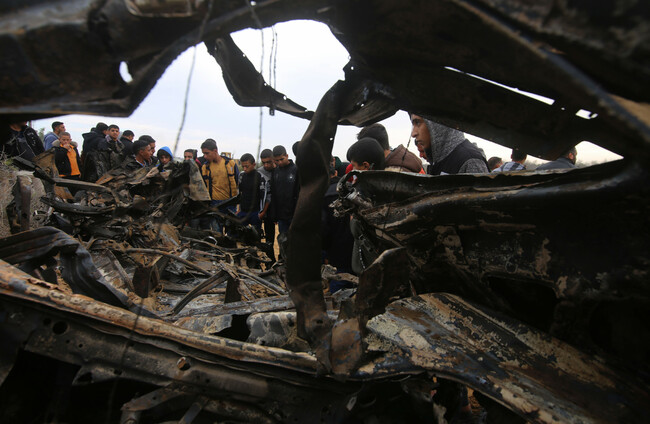
On Sunday, a clash erupted during the covert operation in the Gaza Strip that killed seven Palestinian militants, including a local commander for Hamas’s armed wing, as well as an Israeli army officer.
Covert operation
Prime Minister Benjamin Netanyahu cut short a trip to Paris and rushed home as tensions rose, and on Monday convened a meeting of security chiefs.
UN Middle East envoy Nickolay Mladenov, who along with Egypt has been seeking a long-term truce between Israel and Hamas, called the escalation “extremely dangerous” and said on Twitter that “restraint must be shown by all”.
Israel had stressed its covert operation on Sunday was an intelligence-gathering mission and “not an assassination or abduction”, but Hamas strongly denounced it and vowed revenge.
Israel signalled that Sunday’s mission did not go as planned and resulted in the clash, which Palestinian officials said included Israeli air strikes.
Hamas’s armed wing, the Ezzedine Al-Qassam Brigades, said the Israeli special forces team had infiltrated near Khan Yunis in the southern Gaza Strip in a civilian car.
Months of unrest
An exchange of fire followed in which local Al-Qassam commander Nour Baraka was killed along with another militant, it said.
The car then attempted to flee and Israeli aircraft provided covering fire.
Israel’s military declined to comment on the Al-Qassam account “because of the sensitive nature of the operation”.
A funeral was held for the seven Palestinian militants on Monday attended by thousands, including masked Al-Qassam members carrying rifles, some firing into the air.
The latest clashes came after months of deadly unrest along the Gaza-Israel border had appeared to be calming.
Recent weeks have seen Israel allow Qatar to provide the Gaza Strip with millions of dollars in aid for salaries as well as fuel to help ease an electricity crisis.
Before the flare-up, Netanyahu had defended his decision to allow Qatar to transfer the cash to Gaza despite criticism from within his own government, saying he wanted to avoid a war if it was not necessary.

To embed this post, copy the code below on your site














have your say