Sign in. It’s quick, free and it’s up to you.
An account is an optional way to support the work we do. Find out more.
Sign in. It’s quick, free and it’s up to you.
An account is an optional way to support the work we do. Find out more.
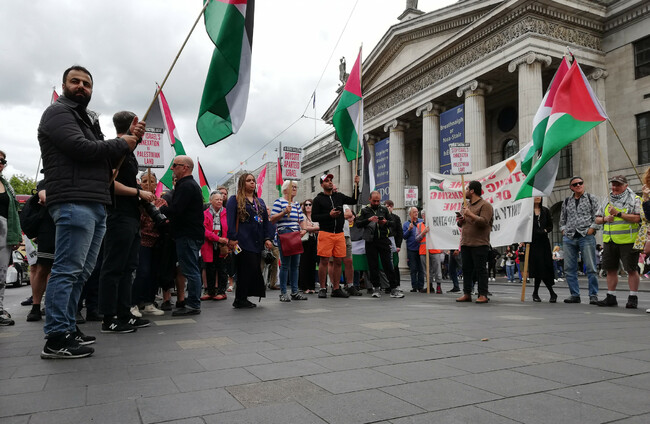
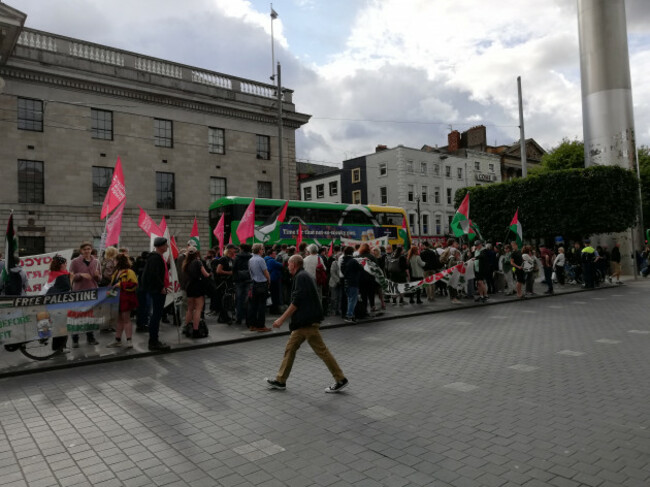
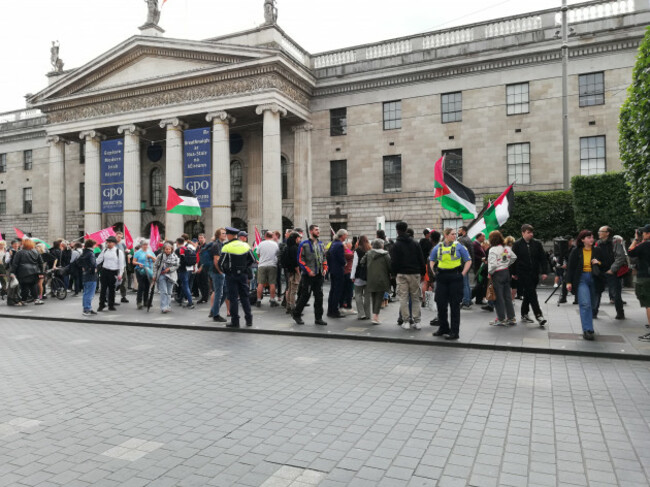
ROUGHLY 150 PEOPLE attended a demonstration on O’Connell Street in Dublin this evening to protest against the Israeli assault on a Palestinian refugee camp in the city of Jenin, which began yesterday and has so far left 10 people dead and many more injured.
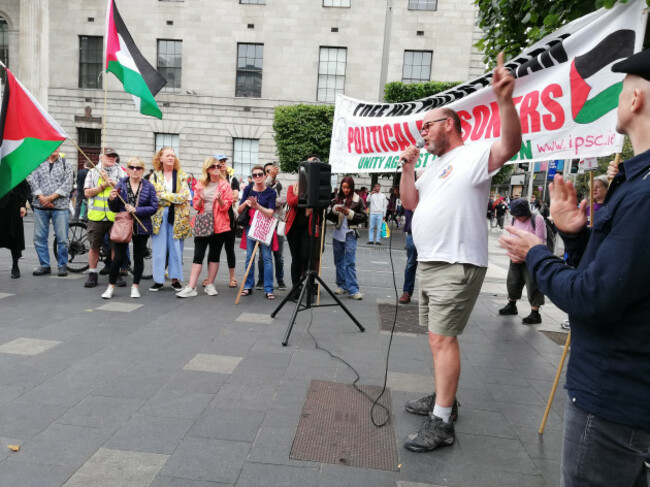
The gathering was organised by the Irish Palestinian Solidarity Campaign (IPSC) and featured speeches and chants led by two spokespeople for the organisation.
People Before Profit TD Bríd Smith, Dublin City Councillor Daithí Doolan and Mags O’Brien of the Trade Union Friends of Palestine also spoke.
Among the themes addressed during the impassioned speeches given at the foot of the Spire were the media’s coverage of the attack, the Irish government’s stance on the occupation in general, conflation of criticism of Israel with antisemitism, Israeli military superiority and the boycotting of Israeli goods.
The reaction of those in attendance to the events in Jenin was one of horror mixed with obvious frustration.
Diaa, from Palestine, was one of those who attended the demonstration. He said the Israelis were attacking people mercilessly.
“They are killing the people by bombs, by shooting guns and without any mercy, without respect for old men… for children. Whenever you shoot any bomb or bullet, it will touch someone, maybe a kid,” he said.
“So, that’s why we’re here to support Palestine and to support Jenin.”
Mags O’Brien said she was “absolutely horrified”.
“I would know people that are in that camp… and anybody who’s been to those camps would know that they’re really small and people are pushed together.
“You’ve got young children there and they’ve been living in fear all their lives.
“If there’s a bomb going to be dropped, there’s going to be a lot of casualties from it.”
She says that the idea that there can be targeted strikes in such a densely populated area is “a fallacy”.
The refugee camp in Jenin was, until many fled today and last night, home to about 13,000 people and covers an area of just 0.42 square kilometres. The population density is about three times that of New York City.
“The situation is getting worse every day,” O’Brien said.
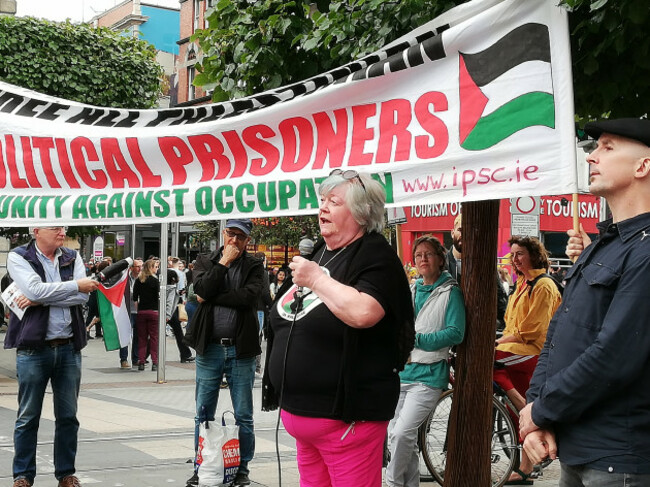
Councillor Daithí Doolan told The Journal “we need to remember that this is a refugee camp under assault from one of the most militarised states in the world, Israel.
“These people have already been made refugees because of the conflict there so they’ve been made refugees again and it’s just horrific to see the attacks television and on social media.”
He said he was there to stand in solidarity with the people of Palestine.
“I just wanted to show, in my own small way, that Dublin stands with the people in Jenin.”
On the Irish government’s approach, O’Brien and Doolan see a lack of action.
“Unfortunately, they talk the talk but they don’t walk the walk. There’s a lot more the Irish government could do but they don’t want to be out of step with the rest of Europe,” said O’Brien.
Brian Ó Éigeartaigh of the IPSC concurred and called on the government to designate Israel an apartheid state, as many human rights organisations have – including Amnesty International and Human Rights Watch.
“The Irish government have to call it what it is and it’s apartheid,” he said.
Chief among the criticisms levelled at the Irish government was the stalling of the Occupied Territories Bill, which aimed to ban the importation of goods from illegally occupied territories like Israel’s settlements in Palestine.
“The occupied Territories Bill needs to be back on the political agenda,” Ó Éigeartaigh said. “It has passed both houses of the Oireachtas, it has wide, cross-party support and it was blocked on a series of spurious pretences.”
The Bill was dropped from the programme for government in 2020, despite passing through both the Seanaid and the Dáil successfully, after pushback from then Tánaiste Simon Coveney and Fine Gael more generally.
At the time, The Journal reported that the government had been subjected to pressure from the Israeli embassy and US lobbying groups.
“Ireland would have one of the most pro-Palestinian polities in Europe but when you look at what the government are doing, they’re refusing to call it what it is.”
This, in his opinion, is the result of pressure coming from the US.
“It’s hard to see it as anything other than cowardice in the face of American pressure.”
The language used in the reporting of the assault and of the occupation more generally came up again and again at the rally, with RTÉ’s coverage on last night’s Six One news coming in for particular criticism.
The main issue pointed to by speakers and demonstrators was that the broadcaster had only featured Israeli voices in its segment on the attack.
In his speech, IPSC co-founder Raymond Deane lamented the widespread use of what he called “the language of the Israeli embassy” in reporting on the assault, particularly the term “military stronghold” when describing Jenin.
One member of the crowd, Liz, from Dublin, said of the coverage in general:
“I just find it so frustrating when the media describe them as settlers and settlements and not illegal settlements.”
When Bríd Smith took the microphone, she made a point of encouraging people not to accept being called anti-semitic when criticising the state of Israel. “Tell them where to go!” she said, describing the Israeli government as “hypocrites and lying bastards”.
She also said the Irish government was “utterly shameful and hypocritical” in how it talked about the conflict, pointing to a minute’s silence held recently in honour of those who have died in Ukraine.
“We’ve never, ever had a minute’s silence for the people of Palestine,” she said.
When asked about today’s car ramming attack in Tel Aviv, which has been claimed by Hamas, Ó Éigeartaigh said it needs to be seen in context and that such attacks are an inevitable result of the Israeli occupation.
“There haven’t been genuine peace talks since 2014. Each successive Israeli government has absolutely rejected the idea of peace talks, so it’s inevitable and unsurprising that some people are taking the law into their own hands.”

To embed this post, copy the code below on your site










have your say