Sign in. It’s quick, free and it’s up to you.
An account is an optional way to support the work we do. Find out more.
Sign in. It’s quick, free and it’s up to you.
An account is an optional way to support the work we do. Find out more.
LAST UPDATE | 25 Feb
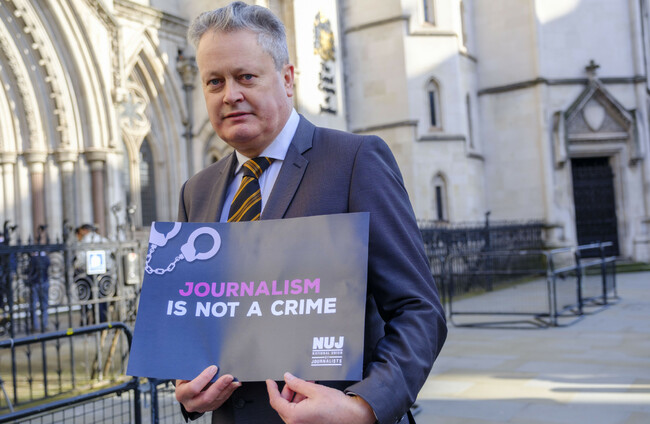
UNLAWFUL STATE SURVEILLANCE of a journalist is an “attack on public interest journalism”, the National Union of Journalists (NUJ) has said, as a tribunal in London begins hearing a case taken by RTÉ Northern Editor Vincent Kearney.
The case before the Investigatory Powers Tribunal (IPT) follows admissions by MI5 that it illegally accessed Kearney’s communications data in 2006 and 2009 while he was Home Affairs Correspondent with BBC Northern Ireland.
The IPT is the judicial body that adjudicates complaints where claimants believe their human rights have been infringed by UK police and intelligence agencies through covert investigation.
The PSNI also admitted today that it illegally obtained phone data from Kearney on multiple occasions over a period of many years.
In one operation against Kearney, it gleaned information relating to 1,580 calls or texts he made and received.
The PSNI also created a “profile” on him, which contained details about his vehicles and the names of his wife and mother-in-law.
Its actions were aimed at identifying his journalistic sources.
The Metropolitan Police has also admitted unlawfully obtaining Kearney’s data twice in 2012.
Kearney, now Northern Editor with RTÉ News, has said the monitoring formed part of a “long and consistent campaign” of unlawful interference aimed at identifying his confidential sources.
He said the activity had an impact on his ability to carry out his work, describing the extent of the admitted illegality as “shocking and stark”.
“The extent of the admitted illegal monitoring of my communications data over a period of many years in an attempt to identify sources was shocking and stark and it’s likely there was more than has been publicly conceded,” said Kearney.
He added that this “conceded illegality has had a real and significant impact and has had a chilling effect on my ability to carry out public interest journalism”.
He also said that his former colleagues in the BBC “also suffered damage to source relationships.”
“These activities were not just an attack on me and my journalism, but also the journalism of the BBC and on public interest journalism itself,” Kearney said.
“Journalists must be free to pursue their lawful duties without fear of illegal efforts by the state to drive a coach and horses through source confidentiality, which is an essential journalistic tenet.”
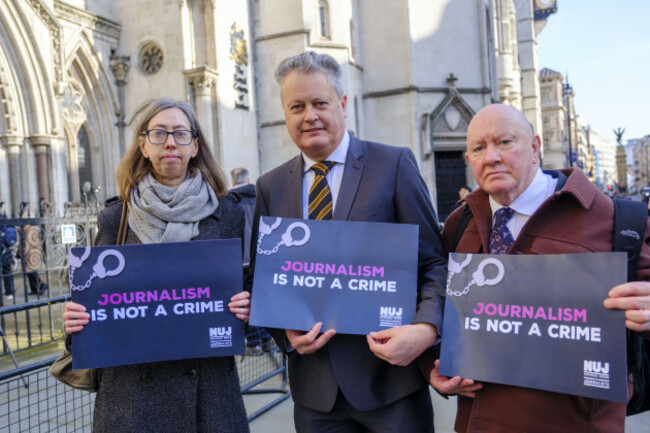
The NUJ said the revelations were “deeply disturbing” and renewed its call for a broader, independent investigation into surveillance of journalists in Northern Ireland.
“This information wouldn’t have come to light without Vincent’s courage and the support of the BBC and his current employer RTÉ,” Laura Davison, NUJ general secretary, said.
“The Investigatory Powers Tribunal process is secretive, protracted and costly, taking a significant toll on the wellbeing of our members.
“The NUJ once again demands a broader, independent investigation to uncover the full extent of surveillance against journalists in Northern Ireland – not only by PSNI but also other police forces and security services,” Davison added.
Adam Smyth, the Director of BBC Northern Ireland, said that what happened to Kearney “was completely wrong”.
“He was treated as a suspect not as a journalist. His rights as a journalist were not respected,” Smyth said.
In a statement this afternoon, RTÉ similarly described the data access as “deeply concerning”.
“Any deliberate circumventing of long established legal protections of journalists and their sources damages trust in media and ultimately our democracy,” Deirdre McCarthy, Managing Director of RTÉ News and Current Affairs, said.
Fran McNulty, NUJ joint president, remarked that “all journalists must be able to pursue stories, investigate issues and engage with sources without any fear of surveillance and intrusion by the state”.
“What has been uncovered in Vincent’s case is of the utmost concern,” added McNulty, who said Kearney will have the “NUJ’s unwavering support”.
The tribunal is expected to sit for several days, with some evidence heard in private. It will consider issues including damages and whether the BBC was itself a victim of unlawful interference.

To embed this post, copy the code below on your site










have your say