Sign in. It’s quick, free and it’s up to you.
An account is an optional way to support the work we do. Find out more.
Sign in. It’s quick, free and it’s up to you.
An account is an optional way to support the work we do. Find out more.


FOR YEARS, IRELAND has successfully walked a tightrope in protecting its enormous corporate tax windfalls.
Amounting to €35 billion last year, the money is single-handedly keeping the country from falling into a financial deficit.
Justifiably compared to Norway striking oil decades ago, the corporate tax windfall is allowing Ireland to put money aside for long-term projects like pensions while covering day-to-day spending (although this probably isn’t the best use of it).
However, there is an uncomfortable truth which often gets overlooked, at least in Ireland – where exactly all this money is coming from.
Ireland is essentially scooping up almost all the tax from many of the biggest tech companies operating in the EU.
New figures published during the week gave some more insight into this.
The Fair Tax Foundation, a British not-for-profit, highlighted that both Apple and Microsoft booked about 90% of their EU corporate income tax for 2025 in Ireland.
Apple’s Irish operations paid out $4.78 billion (€4.38 billion) in tax in 2025, corporate documents show. Apple’s operations across the rest of the EU, covering 18 countries besides Ireland, split about $430 million (€392.44 million) in tax.
It was a similar story for Microsoft. Ireland bagged $6.65 billion (€6.07 billion) from the tech giant last year, according to company filings. The rest of the EU shared about $840 million.

Now, there are plenty of arguments that Ireland deserves this money for one reason or another. Defenders would point to how both companies have substantial operations in Ireland. This is true – both Apple and Microsoft have thousands of workers here, and an established presence.
There are also those who would say that Ireland is just playing by the rules of the international tax game. There is no suggestion either company has done anything illegal by booking such big chunks of their EU profits in Ireland.
Indeed, both Apple and Microsoft have regularly defended their corporate structures, saying that they pay all the tax they legally owe in each country they operate in.
Still, it is difficult to ignore the building European resentment towards this arrangement.
When Apple books a profit from selling an iPhone in Germany (or France or Spain or…), most of the tax on that profit will end up in Ireland.
Rightly or wrongly, many across the EU view this as a fundamentally unfair arrangement.
Especially when it means that Ireland (virtually) alone is the country reaping the rewards from the enormous profits these tech companies make across the bloc.
In September, France’s finance minister specifically pointed this out, calling for Ireland to share the billions and billions in taxes it is collecting with its EU neighbours.
It is a view which is increasingly common across the bloc, with the idea now being floated in some form almost on a monthly basis.
Of course, the suggestion was completely slapped down by Ireland, with the government falling back on its old defence that each EU country is free to set its own tax policy.
It is a decent argument. But it is also worth acknowledging the bigger picture. Ireland’s corporate tax receipts began exploding around 2015. The charge netted the country about €7 billion during the year, a near 50% jump compared to the €4.6 billion recorded in 2014.
This was widely attributed to an international crackdown on international tax havens. As companies looked to move their profits out of ‘dodgy’ zero-tax locations, Ireland emerged as a ‘respectable’ place for companies to book their profits.
The government actively encouraged this, with significant tax breaks for multinationals to move their intellectual property here.
It has, of course, worked out extremely well for Ireland. But the point which many analysts have noted is – easy come, easy go.
If multinationals could adjust their corporate structures to book profits in Ireland, they could likely shift them out again relatively easily.
And there are multiple signs that the international consensus is shifting again.
The EU is currently considering a ‘digital services levy’. Estimated at around 3% of digital sales, the move is effectively an attempt to tap into some of the massive profits the EU feels these tech giants – and Ireland – are not sharing with everyone else.
Ireland, of course, has protested against this. The public argument is that higher taxes would harm EU competitiveness, undermining it as a place to do business.
The realpolitik, of course, is that we want to keep as much of our spoils from the golden goose to ourselves as we can.
Luckily for Ireland, we would have a veto on any EU digital services tax, meaning it is unlikely the government here would have to agree to it unless faced with overwhelming pressure from the rest of the bloc’s nations.
The Taoiseach has also said that ‘global taxation has to be done globally’. Again, the political reality is that it has become essentially impossible to arrive at an international consensus on multinational taxation ever since the Trump administration pulled US support for such arrangements in early 2025.
This is, of course, something the Irish government knows well. It is a convenient excuse, allowing us to reject suggestions to change the tax policies which benefit Ireland.
However, the US is also unhappy with Ireland getting enormous tax receipts from American multinationals. In September, Donald Trump spoke of how Ireland had ‘fleeced’ the US by courting investment from many of its large pharmaceutical companies.
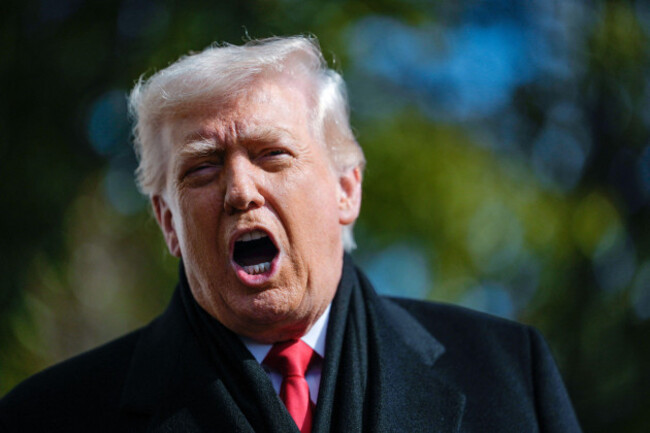
The US has also made various attempts to tempt multinationals to book more of their profits back in the US, something which has the potential to hit Ireland.
But the US and other countries are all pulling in different directions. This is good for Ireland. No international agreement means the status quo remains, meaning we likely hold onto our corporate tax windfalls.
The real danger is if there is any change in the US position. Be it Trump’s term finishing in January 2029 or some shift in the president’s mood. If America decides it wants an international agreement on tax, it could spell bad news for Ireland.
Especially with other EU countries lining up for their cut, and mindful that Ireland has not been eager to share its extraordinary good fortune. We were lucky the last big international tax deal fell so well for us – it is unlikely to happen a second time.
To embed this post, copy the code below on your site

















have your say