Sign in. It’s quick, free and it’s up to you.
An account is an optional way to support the work we do. Find out more.
Sign in. It’s quick, free and it’s up to you.
An account is an optional way to support the work we do. Find out more.
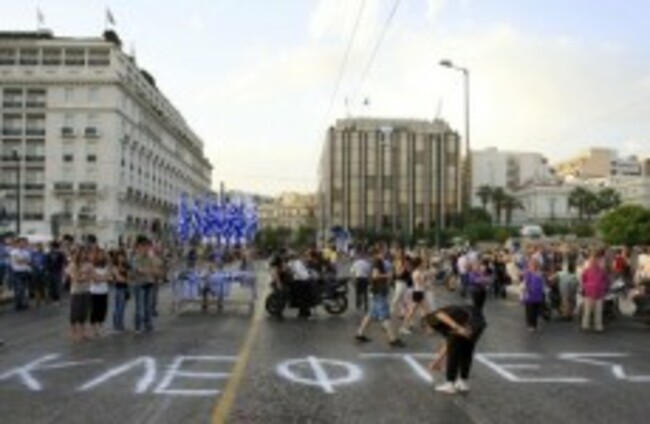
GREECE HAS BEEN told to it correct the under-financing in its adjustment programme in return for the next batch of bailout funds – as unemployment soars to the highest levels recorded since the statistics agency began issuing figures in 2004.
The government had projected an overall unemployment rate of 14.5 percent for this year in its 2011 budget. The situation is expected to get worse as the government imposes yet more austerity measures to meet targets set out in the agreement for Greece’s €110 billion package of rescue loans.
Today, a report by the EU, ECB and IMF stated that the country’s adjustment programme would need further tweaking if Greece were to receive the next tranche of loans, RTÉ reports.
The report stated:
The financing strategy needs to be revised. Given the remoteness of Greece returning to funding markets in 2012, the adjustment programme is now under financed. The next disbursement cannot take place before this under financing is resolved.
Cutbacks and tax increases taken over the past year have already led to anger among workers and unions, which has been compounded by the realization that the measures did not produce all of the results they were expected to.
Ministers are now tussling over the details of additional cutbacks and tax hikes, including €6.4 billion worth of remedial austerity measures for this year, and a midterm program to run from 2012-2015, two years beyond the current government’s mandate.
The government is also pushing through a €50 billion privatization program that includes public utilities. Workers at state companies facing privatization have called their first strike against the plan for Thursday. Joined by much of the state sector in work stoppages, the strike will affect public transport, banks, post offices and the state television and radio stations.
Strikes have affected virtually all sectors at some stage, with workers holding demonstrations or picketing ministry buildings.
On Wednesday, radiology technicians became the latest group to protest, with about 300 gathering outside the Health Ministry in central Athens. The technicians, who held up placards printed on x-ray film, were protesting cuts to extra time off they receive due to their exposure to radiation at work.
Prime Minister George Papandreou is also faced with increasing frustration from within his own Socialist party — and among his ministers — over the new austerity.
Several Socialist lawmakers have criticized the measures, although none have said outright they oppose the plan, due to be voted on in Parliament by the end of this month.
Papandreou was holding a second day of consultations with his party deputies Wednesday before the Cabinet discusses the plan on Thursday and submits it to Parliament.
His finance minister, George Papaconstantinou, came under heavy fire from disgruntled deputies during a marathon meeting Tuesday.
Greek media reported that Vasso Papandreou, head of parliament’s financial affairs committee, accused Papaconstantinou of “lacking a plan and taking measures that will be short-lived.”
Labor Minister Louka Katseli said some of the proposed measures would be “re-evaluated.”
The government also appears shaken by sustained anti-austerity rallies in Greek cities, which climaxed on Sunday with tens of thousands of peaceful protesters in central Athens.
Papandreou suggested after an informal Cabinet meeting on Monday that he was open to holding a referendum on austerity measures, although government spokesman George Petalotis said the following day that there were no immediate plans for such a vote.
Additional reporting by the AP

To embed this post, copy the code below on your site














have your say