Sign in. It’s quick, free and it’s up to you.
An account is an optional way to support the work we do. Find out more.
Sign in. It’s quick, free and it’s up to you.
An account is an optional way to support the work we do. Find out more.
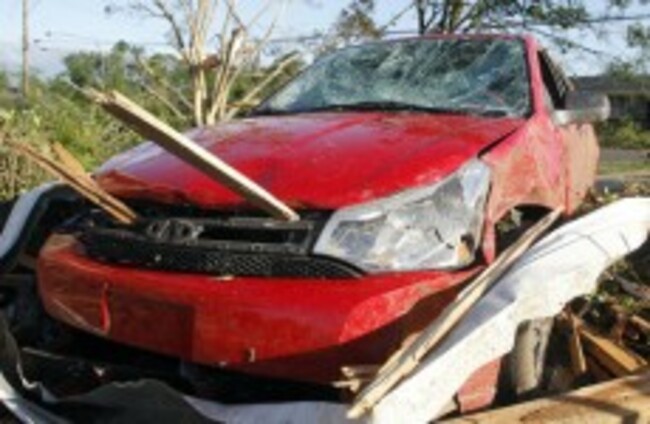
AT LEAST 297 people have been killed across six US states after the country experienced its deadliest tornado outbreak in almost four decades.
More than two-thirds of the dead lived in Alabama.
The twisters left behind half-mile scars across many large cities, and firefighters are combing the remains of houses and neighbourhoods following the catastrophic storms.
President Barack Obama said he would travel to Alabama today to view the damage and meet Gov Robert Bentley and affected families. Late yesterday (Thursday) evening he signed a disaster declaration for the state to provide federal aid to those who seek it.
Residents were told the tornadoes were coming up to 24 minutes ahead of time, but they were just too wide, too powerful and too locked onto populated areas to avoid a high body count.
“These were the most intense super-cell thunderstorms that I think anybody who was out there forecasting has ever seen,” said meteorologist Greg Carbin at the National Weather Service’s StormPrediction Center in Norman, Okla.
If you experienced a direct hit from one of these, you’d have to be in a reinforced room, storm shelter or underground [to survive]
The storms hit interstate highways and obliterated neighbourhoods and even entire towns from Tuscaloosa to Bristol, Va.
Alabama Emergency Management officials said early this morning that the state had 210 confirmed deaths. There were 33 deaths in Mississippi, 33 in Tennessee, 15 in Georgia, five in Virginia and one in Kentucky.
Nearly 800 people were injured in Tuscaloosa alone.
Some of the worst damage was about 50 miles southwest of Pleasant Grove in Tuscaloosa, which is a city of more than 83,000 that is home to the University of Alabama.
The city’s emergency management centre was destroyed, so the school’s Bryant-Denny Stadium was turned into a makeshift one. School officials said two students were killed.
Tuscaloosa Mayor Walter Maddox said that police and the National Guard will impose a curfew at 10pm Thursday, and 8pm the next night. Authorities have been searching for survivors so far, but Maddox said they will begin using cadaver dogs on Friday.
That twister and others Wednesday were several times more severe than a typical tornado, which is hundreds of yards wide, has winds around 100 mph and stays on the ground for a few miles, said research meteorologist Harold Brooks at the Storm Prediction Center.
He said:
There’s a pretty good chance some of these were a mile wide, on the ground for tens of miles and had wind speeds over 200 mph.
The loss of life is the greatest from an outbreak of U.S. tornadoes since April 1974, when the weather service said 315 people were killed by a storm that swept across 13 Southern and Midwestern states.
Brooks said the tornado that struck Tuscaloosa could be an EF5 — the strongest category of tornado, with winds of more than 200 mph — and was at least the second-highest category, an EF4.
Search and rescue teams fanned out to dig through the rubble of devastated communities that bore eerie similarities to the Gulf Coast after Hurricane Katrina in 2005, when town after town lay flattened for nearly 90 miles.
As many as a million homes and businesses there were without power, and Bentley said 2,000 National Guard troops had been activated to help. The governors of Mississippi and Georgia also issued emergency declarations for parts of their states.
The storm system spread destruction from Texas to New York, where dozens of roads were flooded or washed out.
-AP

To embed this post, copy the code below on your site







have your say