We need your help now

Support from readers like you keeps The Journal open.

You are visiting us because we have something you value. Independent, unbiased news that tells the truth. Advertising revenue goes some way to support our mission, but this year it has not been enough.

If you've seen value in our reporting, please contribute what you can, so we can continue to produce accurate and meaningful journalism. For everyone who needs it.

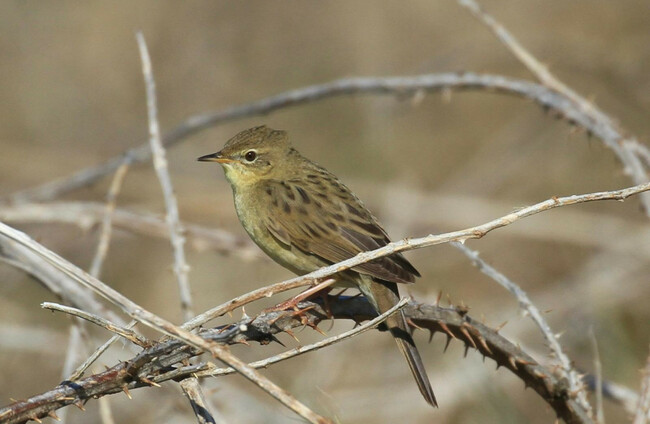
The Grasshopper Warbler (Locustella naevia) Christopher O'Sullivan

Minister for nature We need to work together to protect against biodiversity loss

Launching a new nature restoration report, Christopher O’Sullivan says Ireland’s biodiversity crisis is deepening, but practical, community-led solutions are the answer.

THE GRASSHOPPER WARBLER isn’t an especially striking looking bird. It’s small, mostly brown and notoriously hard to spot. But there I was last weekend, hunkered down in the bushes with my binoculars in a field in West Cork, watching, waiting and listening for its distinctive song – kind of like a long whirr from a fishing reel, or the grasshopper it’s named after.

This is not the kind of behaviour most people expect from a Fianna Fáil politician from a rural constituency, but it’s how I choose to spend whatever free time I get. Seeing these amazing creatures in the wild brings me a great sense of joy – it’s completely magical to hear a bird like this singing from the top of its lungs, knowing that all 13 grams of it has just flown to Ireland from tropical Africa, hoping to find a place to breed and fledge its young.

And that’s where the melancholy sets in. Because I know that the dense vegetation they need to nest in is disappearing here in Ireland. This bird, which has travelled so far, and asks so little of us, is going to struggle to find a suitable habitat. It’s not just this bird either – so many birds, mammals, insects, fungi, plants are disappearing from our countryside.

The vibrant array of species that brought colour to our landscapes is getting dimmer. The chorus of sounds is getting quieter. The sheer variety of life is dialling down, being replaced by something much more monotonous.

This isn’t just a tragedy for nature, it’s a tragedy for people too. We need healthy ecosystems for things that are so basic we take them for granted: clean water, fresh air, flood protection, healthy soils to grow food, wellbeing, a sense of wonder and inspiration, the list goes on.

Common ground

As Ireland’s Minister for Nature, it falls to me to do something about it. This is a huge responsibility, and I understand the sense of urgency that comes with it. Since the Nature Restoration Law was passed in Europe in 2024, I’ve seen that legislation and the plan that all Member States have to implement in order to meet their legally-binding targets, as a beacon of hope on the horizon, pointing the way forward for wildlife and habitats.

The challenge, though, has been to figure out how to bridge the gaps in what is often seen as a divisive debate: environmentalists versus farmers, rural dwellers versus urban people, scientists versus practitioners. In such a complex and contested socio-economic landscape, can we find some common ground? And if we can, what does it look like?

Today may offer some green shoots in that regard. I have received the recommendations from the Independent Advisory Committee on Nature Restoration, led by Dr Aoibhinn Ní Shúilleabháin and made up of farmers, scientists, fishermen, public bodies, environmental NGOs and foresters, on how Ireland should approach nature restoration and the development of our national plan. Today, it will be published in full, and our intention is to bring these recommendations into the heart of Ireland’s response to the Nature Restoration Law.

What’s remarkable about the recommendations is that, not only do they present a consensus vision from a really balanced cross-section of Irish society, they were built on a deep public engagement process that heard from sectoral leaders and communities all across the country – over a thousand people in total. The Committee’s work has demonstrated something that I’ve believed for a really long time: everybody, no matter what their background or walk of life, whether they’re an ecologist or a farmer or a computer scientist or a retailer, a lawyer or a bus driver, everybody wants nature to return to Ireland.

What’s more, the report sets out a way of doing it that I think makes a huge amount of sense: we have to fund it, the State should lead the way on action, and the people who manage our lands and seas – farmers, fishermen, foresters and others – should be paid and incentivised to bring nature back in a way that doesn’t compromise their way of life.

How it can be done

The good news is that these kinds of approaches have been working to some success for a number of years, and there are lots of great examples of projects and schemes all over the country. I visited one two weeks ago in Connemara, The Dúlra Project, where landowners were getting financial rewards for restoring bogs with the help of part-time farmers, fishermen and construction workers from the local area who had been trained in techniques to remove rhododendron and block drains.

These teams were being employed by the local development company, who were also connecting their work with other local projects that were finding creative ways to turn wool into furniture and rhododendron cuttings into biochar.

This is not just about environmental action – it’s about job creation, innovation and connection. And crucially, it’s led by the communities themselves.

The challenge now is to find the funding and the mechanisms to massively scale up these kinds of initiatives nationwide and make it easy for people to get involved. By doing this, I truly believe we can turn the tide on nature loss and create new opportunities for ourselves and our communities in the process.

We have a duty of care now in government to make sure that in the years to come, we can all experience landscapes and seascapes that – rather than being tinged with sadness and regret – are instead alive and thrumming with vibrant, healthy nature.

(And yes, I did spot the Grasshopper Warbler in the end.)

Christopher O’Sullivan is Minister for Nature, Heritage and Biodiversity and Fianna Fáil TD for Cork South-West. The recommendations from the Independent Advisory Committee on Nature Restoration will be available from 2 pm today.

Readers like you are keeping these stories free for everyone...
A mix of advertising and supporting contributions helps keep paywalls away from valuable information like this article. Over 5,000 readers like you have already stepped up and support us with a monthly payment or a once-off donation.

Close
46 Comments
This is YOUR comments community. Stay civil, stay constructive, stay on topic. Please familiarise yourself with our comments policy here before taking part.
Leave a Comment
    Submit a report
    Please help us understand how this comment violates our community guidelines.
    Thank you for the feedback
    Your feedback has been sent to our team for review.

    Leave a commentcancel

     
    JournalTv
    News in 60 seconds