Sign in. It’s quick, free and it’s up to you.
An account is an optional way to support the work we do. Find out more.
Sign in. It’s quick, free and it’s up to you.
An account is an optional way to support the work we do. Find out more.

IT HAS BEEN officially confirmed that the Leaving Cert written exams will not go ahead as planned on 29 July, and instead students will be given ‘calculated grades’.
Students’ teachers will give a percentage mark per subject, based on what teachers conclude they would have received had the Leaving Cert gone ahead as in previous years.
Education Minister Joe McHugh, who has expressed reservations previously on this “predictive” model as being unfair, has said that the system isn’t perfect, but it was the best option given the circumstances.
He said that one of the strong points of the Leaving Cert is that there is anonymity in the system, which this current plan doesn’t offer. He also said that it would be “vulnerable” to legal challenges from students and parents in the future.
The postponement of the Leaving Cert is the first time this has happened since the Leaving Cert in its current format was introduced in 1925, so there are a lot of questions about it.
Here, we’ve answered the main ones based on the information given by the Minister for Education Joe McHugh and the Department of Education’s Inspectorate Harold Hislop at today’s announcement, as well a number of other sources of information.
If we’ve left anything out, email your questions to us: answers@thejournal.ie
How will students be graded?
The students will be graded based on their classwork from the past two years: this might include Christmas exams, summer exams, Mock exams, and orals and practicals.
It is at the discretion of the teacher what subject matter they use to estimate a grade, but the Department of Education has stressed that teachers have a code of practice, “underpinned by the values of Integrity, Trust, Care and Respect”, which will guide their system of marking.
They will give a percentage to their students per subject. Teachers will also have to rank their class of students in order – so if three students get 70%, the teacher must rank them in order of who is most likely to have received the 70%.
This final grade is given to the Department of Education, which will view these grades by comparing them to Leaving Cert averages in previous years.
The teachers’ estimated percentages from each school will be compared against previous years’ Leaving Cert results, and against this year’s Junior Cert results. Here are the sets of data this year’s Leaving Cert exams will be compared against:
This ‘algorithm’, or standardisation, will result in a final ‘calculated grade’ for students.
Is this fair? Doesn’t it leave teachers open to favouritism?
McHugh had great reservations about predictive grading for this exact reason – but this isn’t predictive grade, it’s a calculated grade, and so he has said he’s changed his mind.
“It’s not a ‘teacher’ grade,” McHugh said, adding that his reservations about the Leaving Cert were about the teacher being the sole person relied upon in grading students.

“Fairness is going to be central to what we do,” McHugh said at the press conference yesterday.
“One of the things we talked at length about was the professional judgement of teachers,” which he says “is central to this”.
There will be three steps after the teacher awards a student a percentage, to ensure that there is oversight of the process:
When will students get their results?
The Department of Education document says that “ideally”, the percentage assessments from teachers, then to teacher groups, then to principals, should be submitted by the end of May – so three weeks’ time.
McHugh has said that he would like students to receive their claculated-grade results as close to the Leaving Cert results date as possible, which is the end of August.
How do appeals work?
The appeals process is limited. It involves a three-step process:
Chief Inspector Harold Hislop explained at the Department of Education briefing that it wasn’t possible to ask teachers to reopen and reassess the mark that they gave the students officially.
“What you can’t reopen is the actual estimated score that the teacher gave,” he explained.
“When you think about it, if that score was allowed to be reopened, there would be an incredible pressure on the teacher to increase that score.”

It’s understood that part of the reasoning behind this is the loss of anonymity: if teachers were asked by the Education Department to reassess a student’s exam if that student were to appeal, they would probably be inclined to increase their student’s grade due to that pressure.
Remember, it would be the Irish State effectively asking a teacher to rethink a student’s grade.
After an appeal, if students are still unhappy with their calculated grade, they can take a written exam – a date for which has yet to be decided, but is likely to take place in the autumn after the third-level semesters begin.
It hasn’t been decided whether oral and practical projects will be included as part of these written exams, and that decision is dependant on how many people opt to sit the written exams.
Most importantly – if you sit the written exams, and then get a lower result than the calculated grade, you can choose the calculated grade, or a mix of the two methods of assessment.
A mixed assessment is where a student gets a calculated grade, but can decide to sit a written exam in one or two subjects if they are unhappy with their grade in those subjects.
Why can’t the written Leaving Cert go ahead on 29 July as planned?
In a nutshell, because so many restrictions would have to be put in place, and so many changes would have to be made to the exam to keep students and staff safe, that “it wouldn’t be the Leaving Cert exam”.
Education Minister McHugh explained during a Newstalk interview last evening:
With the health advice that we had, in terms of social distancing, we were looking at a Leaving Cert that would start in July and end in September, a Leaving Cert that would have one subject per day, and papers that would be one-and-a-half-hours long, and basically, it was not the traditional Leaving Cert.
It’s understood that the Education Department was advised that it would take 15 minutes to bring students into the exam hall and 15 minutes to take them out of the exam hall, and they could only be in the room together for a maximum of two hours to comply with social distancing advice.
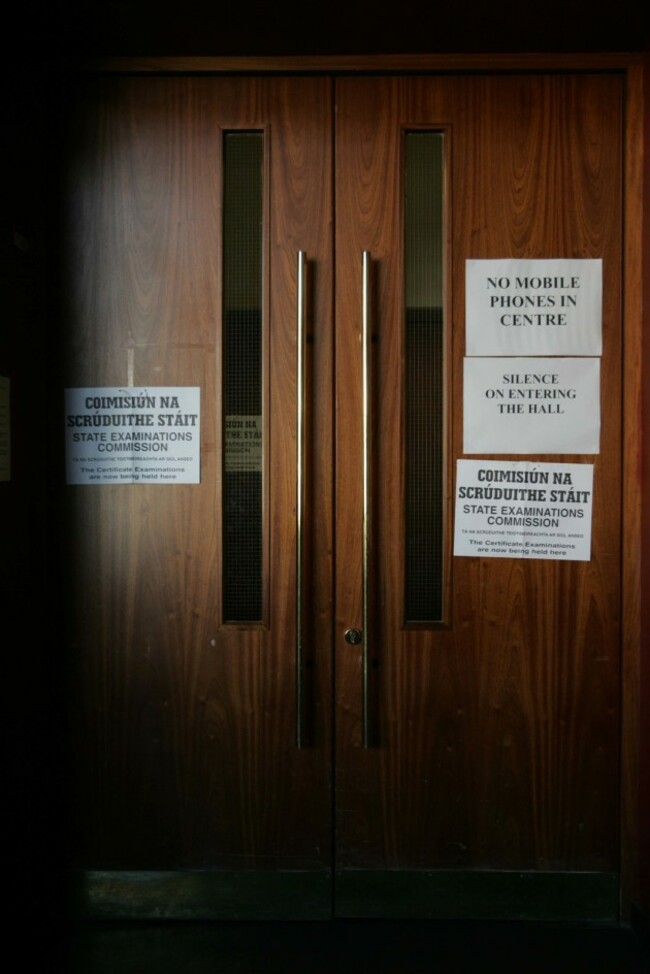
“So we came to the conclusion that we wouldn’t be able to put the Leaving Cert together,” McHugh said, adding that he received advice on Wednesday this week from his Department’s advisory group that they couldn’t stand over being able to execute “a safely run Leaving Cert with the welfare of students at the heart of it”.
“Predictive grades is not a perfect system,” McHugh said, but added that it was the best way of doing things during the Covid-19 pandemic.
What does this mean for the CAO?
The CAO has said that it will treat this year’s Leaving Cert results like any other year – meaning that they will still accept students based on this year’s Leaving Cert results.
If you need a minimum grade in a particular subject to gain entry to a third-level course, then that will still apply.
For more information and supports, click here: https://www.education.ie/covid19

To embed this post, copy the code below on your site













have your say