Sign in. It’s quick, free and it’s up to you.
An account is an optional way to support the work we do. Find out more.
Sign in. It’s quick, free and it’s up to you.
An account is an optional way to support the work we do. Find out more.
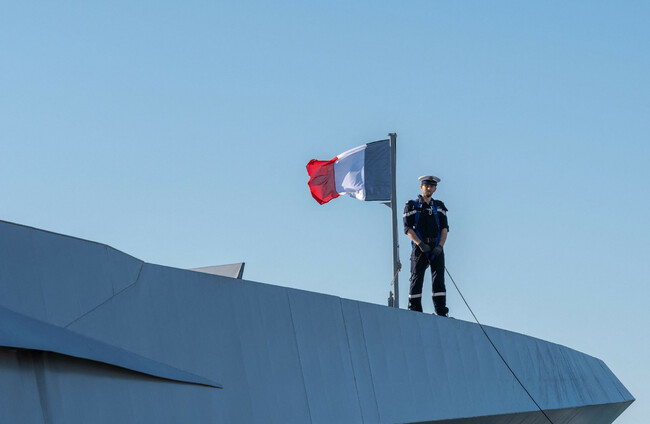
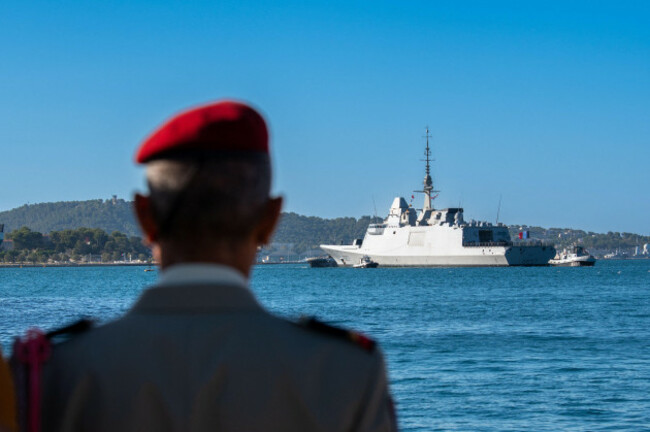
A FRENCH AIR defence frigate has been spotted in the Irish Sea off Dublin Bay as part of a number of additional security measures being taken ahead of Ireland’s launch of its EU Presidency this week.
The ship arrived over the weekend and, according to multiple sources, is between 12 nautical miles and 14 nautical miles off the Dublin coast. Sources have said there were two other military vessels near it at least one is an Irish naval vessel.
The military vessels are masking their presence by not broadcasting on open source ship tracking software – a standard operating procedure for this kind of operation.
The ships were visible on Sunday evening to aircraft flying into and out of Dublin Airport as well as ferries arriving and departing from the capital.
An Irish Coast Guard helicopter also flew out on Sunday evening to the site and its track was visible on open source aircraft tracking software.
A source that observed the French ship said its air defence radar was visibly spinning and scanning as it took up position just outside Irish territorial waters, which extend 12 nautical miles offshore.
The Irish Naval Service does not have any radar capable of identifying airborne threats, so a deal has been struck with France to provide the capability.
The French multi-role frigate is a formidable warship with a hugely powerful air defence radar as well as a passive radar system. It customarily carries an arsenal of anti-air missiles as well as deck guns. It also has the capability to engage surface targets and submarines.
It’s not known what armaments the ship is carrying on its current deployment.
A spokesperson for the French embassy in Dublin declined to comment on the presence of the vessel.
Last week The Journal reported on high level meetings over how the French navy could interact with the naval service here, and around rules on how force could be used in the event of a perceived threat.
The security operation for the Irish Presidency of the Council of the European Union is led by An Garda Síochána as it has responsibility for national security. The Irish Defence Forces can be requested to assist in the operation.
At a recent meeting, Attorney General Rossa Fanning warned of the legal intricacies of Ireland engaging a foreign military to provide the support necessary to secure the presidency.
Central to his warning were concerns around the ‘rules of engagement’ – the protocols for how militaries use force in the event of an incoming threat. There were also concerns from a constitutional basis around the Irish State bringing in a foreign military to assist in its security operations.
Sources have told The Journal that the legal advice for using the French ship is that the foreign crew have the right to self-defence. This principle means that it is for the French crew to decide objectively what is a threat to itself.
It is anticipated it will stay outside Irish territorial waters. Given the secrecy of the operation it has not been confirmed how it will interact with the Irish Naval Service should a threat be identified.
The Irish Defence Forces said, in response to a query, that it could not comment for operational reasons.
Speaking to reporters this morning Minister for Defence, Foreign Affairs and Trade Helen McEntee said she was confident Ireland would have “a safe and secure presidency”.
“I think we’re not immune to risk the same as any other country is not, but I can safely say, and I’m happy to say that we have put in place a huge amount of work, and our gardaí have been planning for this for a number of years now.
“So, the measures that need to be put in place are in place, and I look forward to things kicking off on Wednesday.”
Events kick off in Dublin Castle on Wednesday with the opening ceremony. There will also be events in Cork in the coming days. The Irish Presidency of the European Union Council lasts for six months.
- Additional reporting Andrew Walsh.

To embed this post, copy the code below on your site














have your say