Sign in. It’s quick, free and it’s up to you.
An account is an optional way to support the work we do. Find out more.
Sign in. It’s quick, free and it’s up to you.
An account is an optional way to support the work we do. Find out more.
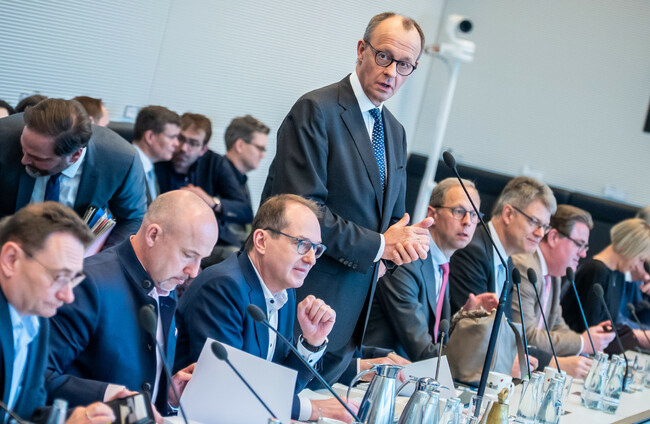
GERMANY’S GIANT SPENDING “bazooka” to beef up its military and modernise its infrastructure passed a final hurdle today after the government signed off on the increased spending.
Chancellor-in-waiting Friedrich Merz had voiced confidence it would pass, as it did through the lower house days earlier, with the help of the Social Democrats of outgoing leader Olaf Scholz and the Greens.
Merz has stressed the need to build up Europe’s defences against a hostile Russia as US President Donald Trump has cast doubt on the future strength of the NATO alliance.
German media have scrambled for superlatives to describe the fiscal plan, labelling it an “XXL-sized” funding “bazooka”.
The package will see strict rules around debt loosened, clearing the way for a spending surge.
The plan exempts defence spending above one percent of GDP from strict debt rules and sets up a 500-billion-euro ($545-billion) fund for infrastructure over 12 years.
All in all, it paves the way for over one trillion euros (dollars) worth of outlays in Europe’s top economy, which has shrunk for the past two years.
Merz’s top priority is to build up the armed forces as fears grow Russia could in the future threaten an EU ally, with confidence waning that the United States would come to Europe’s defence.
Germany has long been reluctant to spend big on its military, and funding dropped off sharply after the Cold War ended.
In recent years, Germany’s Bundeswehr has been mocked for equipment failures, including helicopters that don’t fly and rifles that don’t shoot straight.
Russia’s full-scale invasion of Ukraine three years ago jolted Scholz into action. He announced 100 billion euros in extra defence spending which has allowed Germany to meet the NATO target of two percent of GDP.
But much remains to be done, and the parliamentary commissioner for the armed forces, Eva Hoegl, has warned the military still has “too little of everything”.
Major orders have been placed, including for new German-built submarines, but they will take years to build and deliver.
The chief of Rheinmetall, Germany’s largest defence company, Armin Papperger, said last week that “an era of rearmament has begun in Europe that will demand a lot from all of us”.
German politicians have long complained about late trains, crumbling bridges and vast areas with poor mobile phone and internet coverage.
“We have a lot of infrastructure that dates back to the 1960s and 1970s,” says the transport ministry, which estimates 5,000 bridges need rebuilding.
On the insistence of the Greens, €100 billion will flow into a climate fund and could help pay for projects such as renewable energy and electric car recharging stations.
Experts have voiced hope the spending splurge will help kickstart an economy that has shrunk for the past two years, and boost growth in the wider eurozone.
But analysts warn that money alone won’t be the answer and call for reforms to bring down energy costs, slash bureaucracy and attract more skilled foreign labour.
“Modern infrastructure is essential for one of the world’s largest economies, but it doesn’t inherently drive innovation, sector transformation or new growth opportunities,” wrote ING analyst Carsten Brzeski.
He said “the chances of a cyclical rebound in the German economy… have clearly increased” but also stressed the need for “real structural reforms”.
Otherwise, he warned, the fiscal package “will only be a very huge flash in the pan”.
The money splurge signals a radical departure for a country famously reluctant to take on debt, fearful the repayments will burden future generations.
Aside from green-lighting vastly more borrowing for defence, the package will also allow state governments to run annual deficits of up to 0.35 percent of GDP.
Brzeski wrote that the new package meant that the debt brake “is not officially dead but buried alive”.
Merz – who during the election campaign had insisted he would stick with the debt brake – has stressed that it’s not just a huge pot of play money for politicians.
He has warned the SPD that belt-tightening will be needed elsewhere, especially in welfare spending.
German debt will increase, but experts say that at a current ratio of 62% of GDP – about half that of the United States – there is still room for manoeuvre.

To embed this post, copy the code below on your site













have your say