Sign in. It’s quick, free and it’s up to you.
An account is an optional way to support the work we do. Find out more.
Sign in. It’s quick, free and it’s up to you.
An account is an optional way to support the work we do. Find out more.
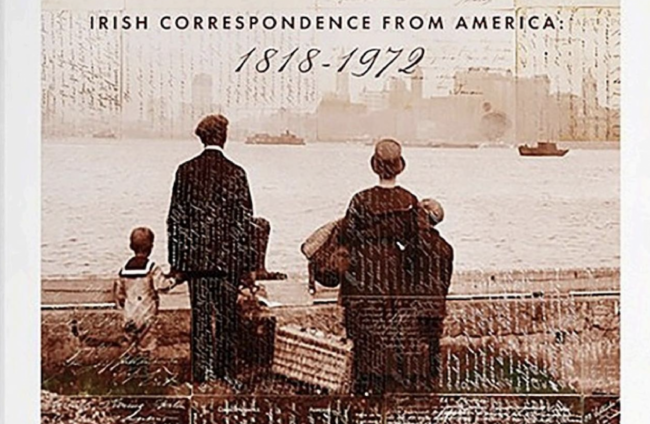

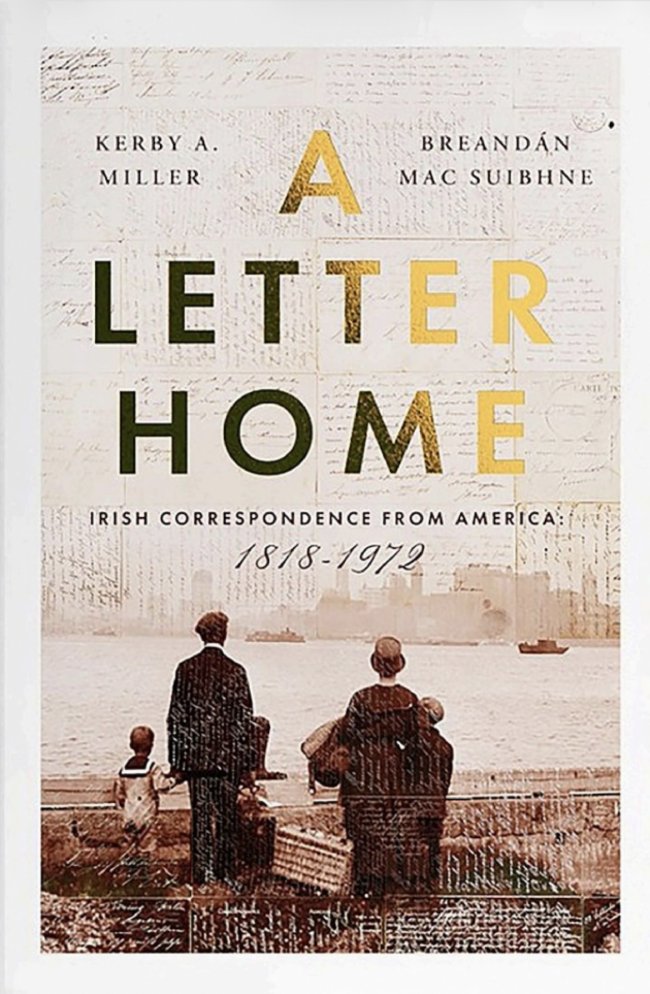
Historians Kerby A. Miller and Breandán Mac Suibhne have written a rich new book ‘A Letter Home – Irish Correspondence from America’. It includes over 60 letters from Irish emigrants in North America, written between the early 1800s and the mid-1900s.
The book is nominated for Best Irish-Published Book, a category sponsored by The Journal in the An Post Irish Book Awards. Here, they share two letters, one from Minnie Markey living in Chicago writing home to Leitrim in 1893, and another written by James Butler in Wisconsin to his brother at home in Kildare in 1853…
In 1893, Mary or ‘Minnie’ Markey was an eager teenage emigrant, excited by the wonders of the Chicago World’s Fair and entranced by America’s material delights (including indoor bathrooms) and romantic possibilities (including dancing lessons).
Unfortunately, Markey’s search for ‘love and liberty’ did not end well, as her emigrant cousin Annie Carroll later reported with malicious glee.
In 1894, Markey eloped to Milwaukee with Annie’s sweetheart, Peter Lowe, a butcher from County Roscommon, discovering too late that he was an alcoholic. In 1896, Lowe died in Chicago, but Minnie’s fate is unknown: she disappeared from family correspondence – her youthful indiscretions too embarrassing for her ‘respectable’ relations to forgive.
I wrote this on the 7th and kept it a few days after
Chicago, Ill., 7 May 1893
Miss Mary Carroll,
My dear cousin, it is with sincere pleasure I sit down to write you these few lines, hoping to find both you and your husband well. Mary, I never really did think that you would ever get married. I thought I would have a chum when I would be an old maid, but I am now disappointed. But Mary I am very glad to hear you are married. I wish you peace and happiness and everything that is pleasant through life. I really forget what your husband looks like. I have seen him so few times.
If you ever get your pictures taken, don’t forget me and send me one. I hope you will give me the full particulars of your wedding when you write, and who you had for a bridesmaid. I seen Annie yesterday; she is well. I wish you had told me when you were going to get married. I would make you a little wedding present, but it is not too late yet. Please tell me are you living in the home in Martinstown or how is aunt Peggy? I often think of her. I wish I was so as I could help her.
I often think of the days we spent together when I used to be calling you at the door for your skerries. We don’t have any nice potatoes here like we used to have in Ireland, but we have other things different here. We have very nice fruit and vegetables here.
Chicago is going to be a very stirring place here this summer on account of the Fair. The President was here, and the Fair is now opened. You have no idea of the way it looks. It is just like a little city all in itself. Just think there is one building in the grounds and it covers forty acres of land. It seems impossible to anyone that does not see it. I was in the building the time of dedication. It was very interesting to see it. I was through the first stories or floor. It was there the soldiers stayed at night and resting when the parade was over. There was a body of soldiers from every state in the U.S.
They came with the governors of the states to dedicate their buildings. Every country in the world has a building here at the Fair, and there was somebody here from every part of the world to represent their own. The soldiers looked very nice in the procession. The parade was ten miles long from the beginning to the end. You must think how nice all the bands was playing together. There was not a band in the country for hundreds of miles but was here. The days was very nice here then.
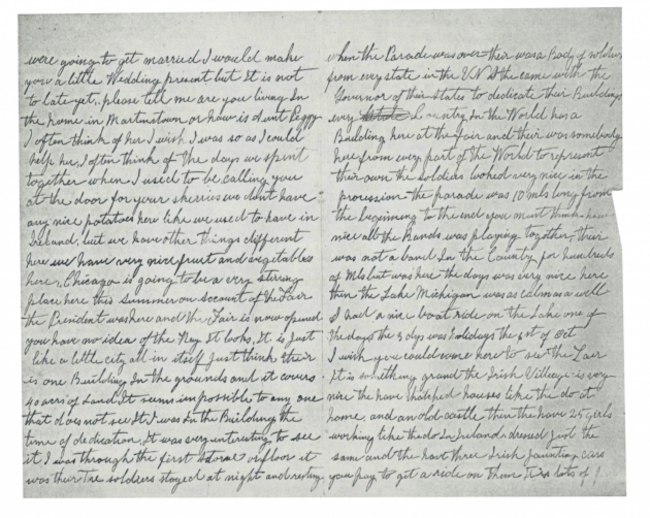
The Lake Michigan was as calm as a well. I had a nice boat ride on the Lake one of the days. The three days was holidays the 1 October. I wish you could come here to see the Fair. It is something grand. The Irish Village is very nice. They have thatched houses like they do at home and an old castle. Then they have twenty-five girls working like they do in Ireland, dressed just the same, and they have three Irish jaunting cars. You pay to get a ride on them. It is lots of fun. They have Lord and Lady Aberdeen here in the little Village, but they are going back to Scotland until fall. They will be back for the closing of the Fair.
Every village has their own way like Ireland. I will tell you when I see more of it. And you know when there is people here from Arabia and all those foreign lands it is funny to see the way they dress, and the Turks are comical looking and the Chinese looks nice. They are making tea and busy at silk weaving. The Esquimamy [are] here from the North Pole. They are here all winter. [They] are all dressed in dog skins from head to foot. They have to live in a house built of ice. They are used to a cold climate. They had a good time here all winter.
The snow was so hard and the ice on the lake was so thick, they would go out and sit on the ice as soon as the daylight came in the morning. They enjoyed the cold winter while we were freezing. It was very cold. They were out in their sleighs and having a good time all winter. I suppose you read all about this in the paper. I will send you a paper often through the time of the Fair when there is anything interesting in it. Please tell me, is there anyone from the parish coming out here to the Fair? If so, tell me, and I will be glad to see them.
I have seen Annie yesterday. She is well. I just see it in this evening’s paper that John Harmon’s wife was killed crossing the railroad tracks. She was struck by the engine and instantly killed. They are only married eleven months. I hope you are having a good time. You would be surprised to see how late spring is here. The leaves did not go to shoot out yet, but when we do have spring, it comes all by sudden. I guess you have trees in blossom at home now.
Please remember me to all the neighbours, and give my kindest regards to your husband Pat and also to aunt Peggy. I will write you a long letter when you answer this one. Well, Mary, please don’t delay in writing to me. I am anxious to hear from you. Please address your letter to this number.
I remain your fond cousin,
Minnie Markey
**********************
Milwaukee, Wisconsin, to his brother Michael Butler, Rathcoffey, County Kildare, 2 May 1853.
Despite America’s vaunted opportunities, Irish emigrants reported that the U.S. economy was highly unstable: bankruptcies were common and employers often less than scrupulous.
James Butler from County Kildare, a carpenter and wheelwright who emigrated in 1849 with his wife and two children, suffered from the consequent insecurities (as well as his wife’s early death from consumption) as he travelled from Milwaukee to Green Bay, Wisconsin, to Chicago, and by mid-1853 back again to Milwaukee, where he wrote this letter, searching for steady employment and a pious environment in which to raise his children.
Apparently, he was successful: around 1861 he remarried, and by the 1870s he owned a wheelwright’s shop in Aurora, Illinois, as well as a 100-acre farm outside the town.
Milwaukee, 2 May 1853
My dear brother,
At last, I have answered your kind letter, which I should have done long since I admit, but I must try and soften the matter a bit. When I describe my unsettled situation, I know you will forgive me. At the time I got your letter I was unsettled as to my staying at Green Bay or going to New York. My intention was for the latter, but providence willed it otherwise.
The boss I worked for owed me $30 and I could not get it out of him, so I determined not to leave until I would be paid. I was working with another man that promised me work all fall and winter at house building, as there was no wagon making going on there nor since I left Milwaukee did I work at it now three years – but the snow fell so early in the fall that the outdoor work was all knocked in the head and I forced to fly to Chicago where I have been working all winter at 10s. a day.
But like Green Bay, I was unfortunate. The firm I worked for, Kemp & Foreside, a Scotch company, closed, leaving me at a loss of $35 which I never expect to get, and lost my health into the bargain. Having to work outside most of the time, I got a very severe cold which settled on my chest with a great cough. [It is] now six weeks since I took it, first part of the time in bed and the rest lingering about but never a day able to work, which is a great loss to me as our men have from 12s. to 14s. per day at present. But you see by this I am writing from Milwaukee, thinking a trip across the lake would do me some good, and as I was able to see Peter and his Mrs. I am staying there for a few days to recruit myself and finds myself a great deal better.
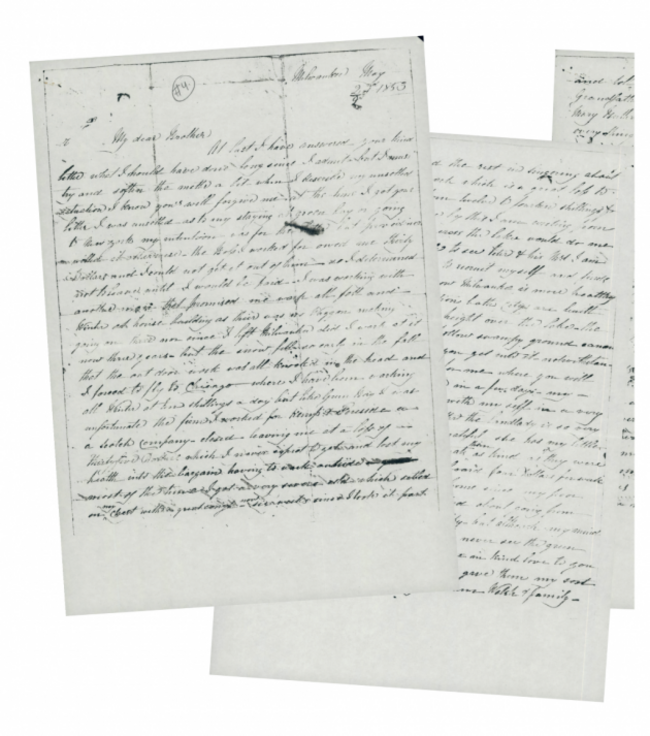
I know Milwaukee is more healthy than Chicago from the situation both cities are built on – Milwaukee on a great height over the lake, the other quite the reverse in hollow swampy ground, [and you] cannot get a view of the city until you get into it.
Notwithstanding, Chicago is the best place for me, where you will direct your letter, as I will return in a few days. My children are at Chicago stopping with myself in a very good boarding house, and what is better the landlady is so very kind to them, for which I feel so grateful. She has my little girl to sleep with herself and treats them as kind as they were her own. I pay for their and my own board $4 per week, [which is] not out of the way. I often think of home since my poor companion died. We are so tired about going from place to place that I feel very unhappy. But although my mind turns that quarter, probably I may never see the green land of Erin.
Peter and wife joins me in kind love to you and Mary – also all enquiring friends. Give them my most sincere regards, not forgetting William Walsh and family, and tell him Lawrence often speaks of his grandfather and Johny and the black ass and aunt Mary Gunther’s hens, chickens and ducks.
In fact, he remembers everything and cries when anyone belonging to him is mentioned. I told him I would write home from Milwaukee, and he says, ‘Pa send my love to them.’ They are my only consolation now. Lawrence is a fine big boy, goes to school every day and seems most anxious to learn, and Eliza is such a quiet, winning child that everyone likes her. I am now writing to the man that owes me the $30 at Green Bay, thinking perhaps he will pay me as he made a fair promise when I was leaving which I hope he will stick to.
Dear brother, I trust you won’t take pattern like me in delaying writing, for in looking on your letter I find it is a year since you wrote – but please to answer this as soon as you can, letting me know how you and Mary are getting on, and all my friends and neighbours that I left behind me. We had a Rev.
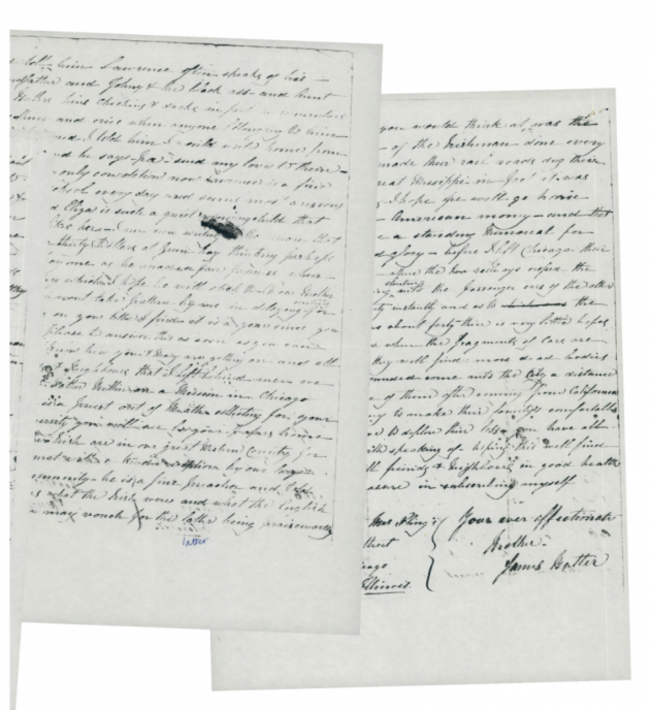
Father Mullin on a mission in Chicago. I think he is a priest out of Meath collecting for your Irish university. You will see by your papers [at] home how strong the Irish are in our great western country for I know he met with a kind reception by our large Catholic community. He is a fine preacher and told the Yankees what the Irish were and what the English were.
Also, you may vouch for the latter being praiseworthy. To hear him talk, you would think it was the great sinewy arm of the Irishman done everything in America – made their railroads, dug their canals, stopped the great Mississippi – in fact, it was they done everything! I hope he will go home with plenty of our American money, and that Ireland may have a standing memorial for to tell of her faded glory.
Before I left Chicago there was a great collision where the two railways crossed, the engine of one running slanting into the passenger cars of the other killing upward of twenty instantly, and as to the wounded which was about forty there is very little hopes of their recovery, and when the fragments of the cars are removed, doubtless they will find more dead bodies.
I have seen the wounded come into the city a distance of ten miles, some of them often coming from California with plenty of money to make their families comfortable, but now will have to deplore their loss. You have all the news now worth speaking of. Hoping this will find you, Mary, and all friends and neighbours in good health, I find great pleasure in describing myself.
Your ever affectionate brother,
James Butler
**********************
‘A Letter Home – Irish Correspondence from America’, written by historians Kerby A. Miller and Breandán Mac Suibhne is nominated for Best Irish-Published Book, a category sponsored by The Journal in the An Post Irish Book Awards 2026.
To embed this post, copy the code below on your site













have your say