Sign in. It’s quick, free and it’s up to you.
An account is an optional way to support the work we do. Find out more.
Sign in. It’s quick, free and it’s up to you.
An account is an optional way to support the work we do. Find out more.
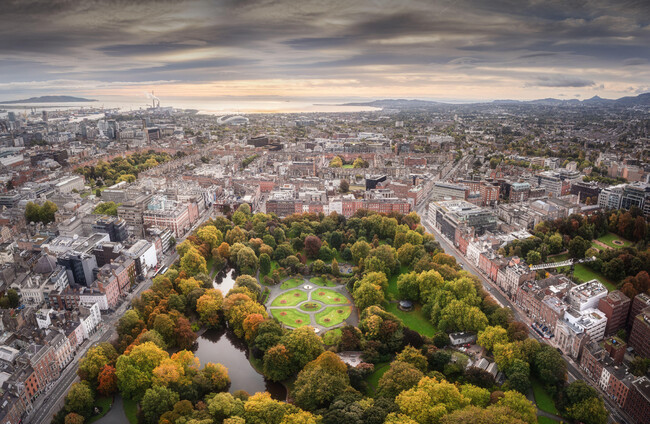

DUBLIN HAS ENORMOUS potential to become one of the most bicycle-friendly cities in the world, yet it remains one of the most congested, clogged with cars and traffic. And make no mistake, Dublin’s congestion is not an accident, but rather policy and planning working exactly as intended. And the consequences are enormous, as our continued reliance on cars as the dominant mode of transport contributes significantly to carbon emissions, local air and noise pollution, road injuries and deaths, sedentary lifestyles and social isolation, to name but a few negative impacts.
Rhetorically, Dublin has an impressive active travel network. If you click into the active travel programme on the Dublin City Council website, you’re met by the following quote: “Dublin City Council’s Active Travel Network consists of 314km of high-quality, safe and inclusive walking and cycling infrastructure”. Note the use of the word “consists” in its present form. The network is often presented as it is already in place, but in reality, only about 40 km has actually been delivered. Thus, Dublin’s active travel network exists mostly in rhetoric, not reality.
To me, this is but one of many examples of Dublin City Council’s flawed approach to active travel infrastructure. There is a clear lack of transparency, but worse, the entire approach seems guided by the following principle: put in some cycle paths, but only on the condition that drivers are never inconvenienced. The end result feels like tokenism coupled with continued encouragement of mass car ownership. Nobody benefits.
Take for instance the recent EU summit. Yes, much of the city centre was essentially blocked off for days, but it was perhaps a more subtle aspect that struck me the most. As the quays were blocked off in preparation for the summit, it was the footpaths and cycle paths that were closed first. The roads were kept open for as long as possible. The message from Dublin to the European leaders was loud and clear: that here, the car takes priority. If you walk or cycle, get out of the way.
This speaks to a much deeper issue within Dublin. Everyone who walks or cycles around the city will be familiar with how, every time there are roadworks or similar disruptions, it is almost always the cycle paths and footpaths that disappear. Often out of nowhere without any warning.
Just up the road from the quays, work has begun on an active travel scheme along the North Circular Road between Dorset Street Lower and Amiens Street. But as part of the construction work, what little space people cycling had (mostly a narrow painted cycle lane) has been removed, forcing them to merge with traffic, often in the middle of a junction. Thus, in their efforts to improve active travel infrastructure, they are actively making it more challenging to cycle. Worse still, the timeline for the project is 18 to 20 months for a meagre 1.1 km stretch of road. With the expected delays, that could easily become two years of roadworks during which people cycling must endure even more dangerous conditions than the already hazardous baseline.
In contrast, in cities such as Copenhagen people on bikes are almost always prioritised during roadworks. Not only are these temporary solutions often better than the permanent ones we have to contend with in Dublin, but they speak to a wider culture of prioritising people, not cars.
This is not a nice-to-have, but a must-have. Keep people safe, then give whatever space remains to cars, not the other way around. It is rhetoric turned into action. That is sorely lacking in Dublin. Similarly, when the city centre was closed off for the EU summit, people cycling were forced to take other, less safe routes across the city. No alternative cycle routes were put in place. Instead, it was dog-eat-dog.
This leads on to the wider issue of a lack of delivery. As mentioned, Dublin City Council has committed to providing a 314 km active travel network. However, this does not mean 314 km of cycle paths, but rather a combination of cycling, walking and mixed infrastructure — the breakdown of which remains unclear to me.
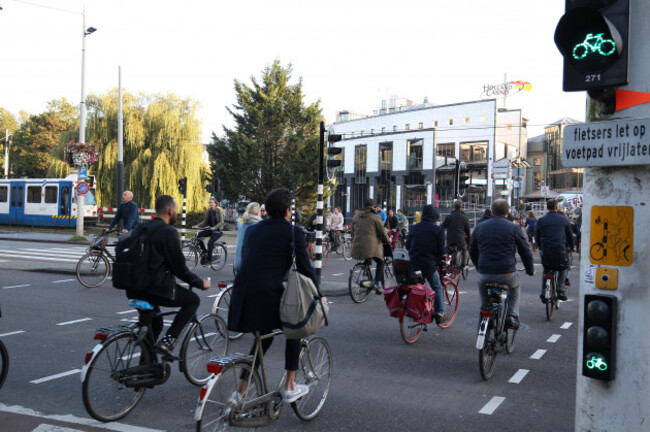
Unfortunately, there are problems with both quality and quantity. Across most schemes, Dublin City Council’s approach to active travel infrastructure seems to just ignore best international practice. Instead of using Dutch or Danish standards as a minimum, the council seems set on developing its own standards. We should aim to build a network that would make the Dutch or the Danish envious: a network of cycle paths that could not only accommodate but encourage hundreds of thousands of people to cycle every day. As it stands, that is not what Dublin’s network consists of, or rather, will consist of.
Which brings us to quantity. Dublin City Council continues to introduce active travel infrastructure at a painfully slow pace. It doesn’t help that the funding for DCC’s active travel initiatives has reduced from €45 million last year to €35.95 million this year.
This slow progress is perfectly captured by the recent publication of a project to install active travel infrastructure at a simple four-road junction between Milltown and Donnybrook. It will not take eight days, nor eight weeks, but eight months to complete. Yes, you read that right: eight months to redo a small, uncomplicated junction — and that does not include the inevitable delays. This even makes the North Circular Road scheme seem quick. Or scratch that, 1.1 km divided by 20 months is about 183 cm per day. If you applied a similar pace to constructing the Dublin to Galway motorway, it would take roughly 300 years to construct the entire road. Yes, cycle paths and motorways are not the same, but you get the idea.
It is therefore unsurprising that, according to Dublin City Council’s own published data, only two kilometres of new active travel infrastructure were completed in the first nine months of 2026. At that pace, we will be well into the next century before we have anything close to a 314 km network. And remember, a network is only as a good as its weakest part. One poorly designed junction can be enough to prevent a child from cycling to school on their own or a pensioner cycling to the shop.
According to the National Transport Authority (NTA), every €1 invested in active travel infrastructure generates almost €4 in benefits for society. This is a remarkable return on investment for our society, but the numbers for individuals are perhaps even more impressive. According to the same NTA report, a commuter who cycles can save up to €3,480 annually compared to driving. In a cost-of-living crisis, making cycling accessible is an immensely powerful intervention. But instead of doubling down on cycling, an investment that will benefit us all, we double down on more fossil fuel subsidies.
And let us not forget that there are real lives behind these numbers. The lack of basic active travel infrastructure has a significant impact on livability, human and planetary health, and people’s independence.
Conversely, by making cycling universally accessible through world-class infrastructure, we can not only improve quality of life for the people of Dublin, but also reconnect communities, and give people back the freedom of movement, the freedom to live healthy lives. The positive synergistic effects of a more cyclable Dublin are almost endless.
So imagine if Dublin City Council had used this summer to change our transport habits. Inspired by what the Dutch and the Danes did during the oil crisis of the 1970s, we could have done the same in response to the current one: active travel infrastructure at an unprecedented scale. It could have been crowned by an EU summit surrounded by people walking and cycling, showing European leaders that we are able to transform our transport system — one that promotes health for both people and planet.
The Danes and the Dutch did not embrace pedal power automatically. They did so because policy and action encouraged them to. There was ambition and true political leadership, both of which are almost completely absent in Dublin.
And no, this is not a war on cars or on people driving. Instead, I would argue that the current reality is a war on people. By recognising that, and the fact that Dublin could change almost beyond recognition, fast, we must hold Dublin City Council to account, and demand more.
Because as it stands, the way active travel infrastructure is being delivered in Dublin is not working, and no small tweaks will fix this inherently flawed approach. It is time for a paradigm shift.
If we get it right, Dublin will become a city that moves. For all.
Dr Ola Løkken Nordrum is an anaesthesiology trainee and committee member of Irish Doctors for the Environment.
To embed this post, copy the code below on your site













have your say