Sign in. It’s quick, free and it’s up to you.
An account is an optional way to support the work we do. Find out more.
Sign in. It’s quick, free and it’s up to you.
An account is an optional way to support the work we do. Find out more.
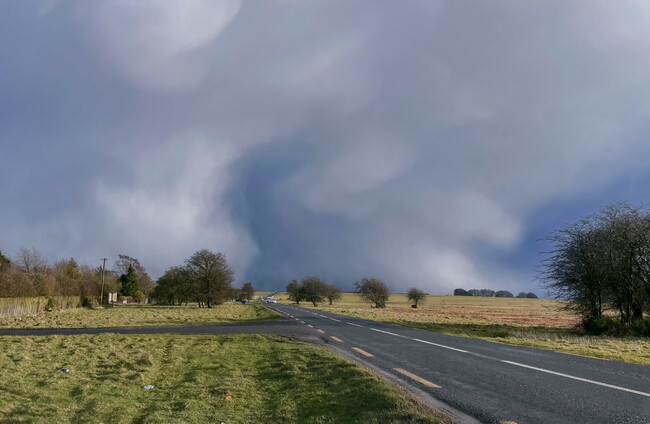
IF YOU’VE BEEN feeling whiplash from extreme weather changes in recent days, you’re not alone.
There is a distinct lack of Leaving Cert weather, as sunny spells are suddenly interrupted by lashing rain.
You could be standing in a downpour while in the not-so far distance, skies are blue.
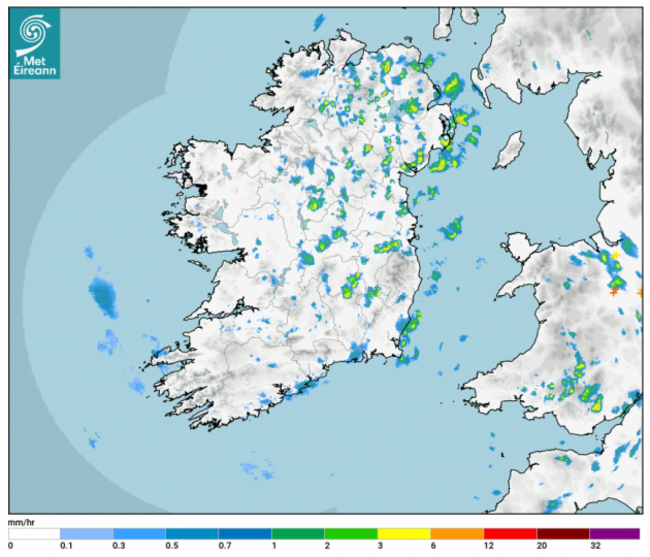
Linda Hughes, a meteorologist at Met Éireann, told The Journal that rather than a large continuous band of rain, we’re seeing small, fast-moving clusters.
“When it’s breezy, that can move the showers along quite quickly, so they’re not really stalling over any particular area for very long,” she explained.
“Because they’re very small in size, they don’t really stay in one place too long, and that’s why suddenly you’ve got sunshine changing into very heavy rain.”
Radar imagery shows small clusters of clouds dotted across the country, with medium precipitation levels.
Some people are particularly irked by the showers appearing in June, when summery weather is expected.
Hughes explained that, in fact, warmer temperatures contribute to heavy showers.
“We’ve warmer air near the surface of the earth [and] colder air higher up in the atmosphere.
“It starts cooling down once it’s high up in the atmosphere. Then the water vapour in the air condenses and turns to liquid. So basically that turns into raindrops.”
The raindrops build up inside the small, scattered clouds until they become too heavy and release rain, Hughes explained.
They’re called cumulonimbus clouds. The term derives from the Latin words cumulus (heap) and nimbus (rain).
So, why has Ireland got such changeable weather?
It comes down to our location.
“We do have seasons, obviously, and summer is meteorologically and statistically the warmest season of the year, but that’s averaged out over the three months,” Hughes explained.
“We’re kind of on the borderline of different air masses, so we’ve got colder air to the north and warmer air to the south.”
Ireland can end up on either side. Recently it’s been the colder side, but at the end of May, for example, we experienced a heatwave.

To embed this post, copy the code below on your site
















have your say