Sign in. It’s quick, free and it’s up to you.
An account is an optional way to support the work we do. Find out more.
Sign in. It’s quick, free and it’s up to you.
An account is an optional way to support the work we do. Find out more.
LAST UPDATE | 15 Mar 2020
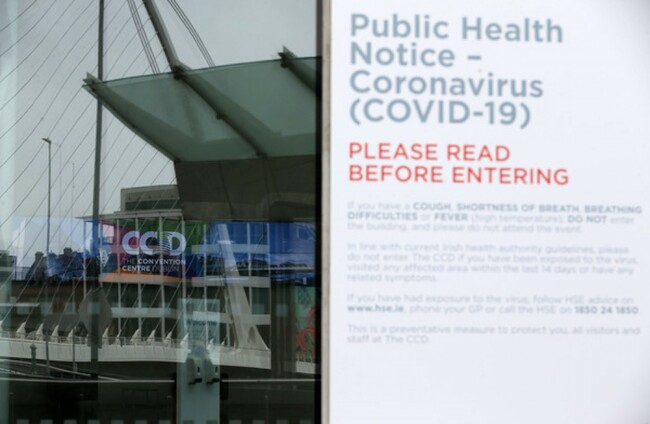
THERE ARE NOW 129 confirmed cases of Covid-19 in the Republic of Ireland after the Department of Health announced 39 new cases, as well as a second coronavirus-related death, yesterday evening.
The jump represents the highest increase in a 24-hour period since the coronavirus was confirmed in Ireland.
As of 2pm today, 11 new cases have been confirmed in Northern Ireland – bringing the total number of cases there to 45.
Yesterday, representatives from the Irish government – including the Taoiseach and Tánaiste – met with their Northern Irish counterparts to discuss the situation on the island.
First Minister Arlene Foster said that now was not the time to follow the lead of the Irish government and close schools and colleges, an approach Deputy First Minister Michelle O’Neill has criticised.
Meanwhile some pubs and restaurants have announced that they’re closing their doors in response to the Covid-19 outbreak as Chief Medical Officer Dr Tony Holohan warned people to adhere to social distancing guidelines.
Internationally, US President Donald Trump has tested negative for Covid-19, his physician has announced, following concerns over his exposure to the novel coronavirus.
Here are the main points today:
This morning, pressure is growing on pubs and restaurants who are seen to be defying the social distancing guidelines issued by the government in response to the coronavirus Covid-19 outbreak.
Taoiseach Leo Varadkar has threatened to seek Dáil backing for “enforcement powers” against establishments ignoring the rules, while senior politicians also took to Twitter to criticise pubs seen to be flouting the measures.
With Ireland only a few days into the unprecedented measures announced on Thursday, a delegation of Irish politicians – including Varadkar and Tánaiste Simon Coveney – travelled to Armagh to discuss North-South cooperation in the face of the coronavirus crisis.
While Ireland has closed schools and colleges and public buildings in response to Covid-19, the North’s Executive has said that now is not the right time to take the same measures there – despite high-profile criticism from Deputy First Minister Michelle O’Neill.
“When we receive that advice we will act on that advice and make sure we do everything in our power to try to protect our citizens,” First Minister Arlene Foster said yesterday.
Across the country today, churches will be shut in a bid to tackle the spread of the virus – which is said to be particularly dangerous for older people.
Last night, the Irish government also upgraded travel advice for six countries in the EU – Poland, Slovakia, Czech Republic, Malta, Cyprus and Denmark – warning against all non-essential travel to the countries.
Trump tests negative
Trump has tested negative for Covid-19, his physician has announced, following concerns over his exposure to the novel coronavirus.
Trump agreed to the test after coming into contact with several members of a Brazilian presidential delegation who visited his resort in Florida, who have since tested positive for the virus.
“This evening I received confirmation that the test is negative,” the president’s physician Sean Conley said in a memo last night.
Trump had dismissed concerns over his exposure to the disease which has killed at least 51 people in the US and led to millions working from home and the closure of schools.
Here are the main international points:
The UK government has so far faced criticism – including from the World Health Organisation – for its “herd immunity” approach to the coronavirus.
This morning, UK health secretary Matt Hancock said that elderly people will be asked to self-isolate for up to four months.
He said it is a “very big ask”, but it is a measure which is for their own “self-protection”.
He also confirmed that ministers were seeking to give police powers to arrest and forcibly quarantine people who are sick with the virus but are not self-isolating.
“We are going to take the powers to make sure that we can quarantine people if they are a risk to public health, yes, and that’s important,” he told the Andrew Marr Show on the BBC.
Hancock said the steps are “very, very significant and they will disrupt the ordinary lives of almost everybody in the country”.
UK’s Covid-19 death toll rose on Saturday from 11 to 21, while the number of people testing positive for the disease passed the 1,000 mark.
Prevention
Covid-19 is spread through droplets caused by sneezing or coughing, or by touching a surface that someone has sneezed or coughed on within a particular time frame. It cannot be passed through your skin, and it’s thought that it’s unlikely to be airborne.
It may take up to 14 days for symptoms to show.
The best ways to protect yourself and others from the virus are to wash hands properly and often, cover your mouth and nose with a tissue/your sleeve when coughing and sneezing, and put used tissues in a bin and wash your hands.
Symptoms of Covid-19 include:
Further resources:
A helpline for older people who are concerned about the coronavirus has been launched by Alone. The number is 0818 222 024, and it’s open Mon-Fri, 8am-8pm.

To embed this post, copy the code below on your site










have your say