Sign in. It’s quick, free and it’s up to you.
An account is an optional way to support the work we do. Find out more.
Sign in. It’s quick, free and it’s up to you.
An account is an optional way to support the work we do. Find out more.
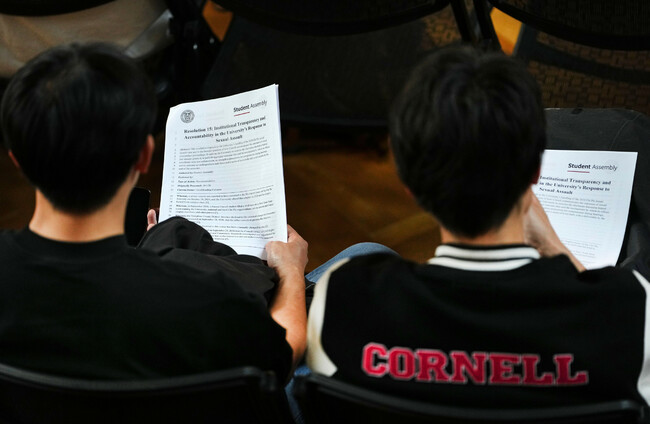
THE INTERNET LETS anyone be who they want to be, but at some point, everyone chooses to be a detective.
It’s easy when social media supplies would-be investigators with an endless trail of photographs, half-stories and apparent clues to solve mysteries that don’t really need solving.
Like the flawed protagonists of hard-boiled novels, amateur sleuths can become so absorbed in the mystery that they lose sight of the people caught up in it and walk deeper into morally questionable labyrinths.
This week, my social media feed brought me an army of amateur investigators who thought they had plenty to expose but who actually established very little around the rape allegations at Cornell University.
In 2024, a woman at the New York college alleged that she was raped by several members of its Chi Phi fraternity.
No criminal charges were initially brought in the case; Tompkins County District Attorney Matthew Van Houten said the statement his office received did not establish grounds for prosecution, an explanation challenged by the woman’s lawyer.
The investigation reopened this week following renewed attention prompted by her September civil lawsuit.
On Thursday, New York Attorney General Letitia James was appointed special prosecutor to investigate the allegations.
As if the facts of the case weren’t bleak enough, the allegations have also attracted false claims and speculation.
Some users believe the accused men got away with merely writing essays, rather than the expulsions and suspensions Cornell says it imposed.
Other posts have mocked the woman at the centre of the case for pursuing damages in civil court, as though seeking compensation was itself evidence that she had invented the incident.
There are also those on the internet who have rallied around the woman in the case and sought to protect her identity; make what you will of the fact that none of those posts appeared to me this week.
There are serious questions about what happened and how the authorities responded in what is a complex legal case involving consent, drugs and alcohol.
But none of that becomes easier to answer when strangers add details and assign motives from behind a keyboard.
I normally steer clear of the misogyny and moralising these cases attract online. But this week, something beyond the usual trial by public opinion kept appearing in my feed.
What caught my attention was the prurient commentary attached to photographs of a woman they claim is Jane Doe and a man presented as her current boyfriend, screenshotted from Facebook and Instagram.
“I get why people have a cuck fetish, imagine this beauty with her sassy charm bringing over her army of bulls to her dorm room and you get the pleasure of watching,” one such post said.
I saw loads of similar posts displaying the couple’s names and social media handles, although the complainant is identified in court papers as Jane Doe and I had seen no verified link between her and the people pictured.
One user acknowledged that the identification was unconfirmed, informing others that they had “batch downloaded” her social media posts in case it was later confirmed to be true.
I couldn’t see what these photographs were supposed to establish about the allegations, but their usefulness to people looking for someone to humiliate was obvious.
The sexual commentary tells us little about what happened at Cornell, and quite a lot about what these posters want us to think about the woman they have identified.
Their ordinary photographs became props in a story that strangers had written online: the man became someone to pity or mock, the woman someone to expose and ridicule.
It was clearly an attempt to dress up sexual humiliation dressed as an investigation.
The mistaken identity of the people in the images would compound the harm to them, but the correct identification of the woman would not, by itself, establish any public interest in circulating the photographs either.
The posts I saw offered no verified link between the couple and the case, but that uncertainty did not stop the photographs circulating.
The identification of the couple was repeated as though repetition itself amounts to proof.
Their exposure came with little apparent consideration of whether the intrusion was justified.
It was a grim layer on top of what’s already a horrendous case, and I couldn’t help but notice the parallels between this and the recent Lindsay Clancy case, where discussion of the deaths of three children expanded into scrutiny of their father Patrick’s relationship with his new wife.
The circumstances were very different, but the assumption felt familiar: publicly accessible photographs were seen as fair game, and anyone connected to the story could be made to account for their private life.
High levels of engagement mean the scope for investigations expands, because that behaviour is seen as rewarding.
The problem only multiplies when people repeat claims or re-share photographs to the point that this becomes evidence in its own right.
There is a thrill in being first to find something and winning approval from an invested audience.
Believing that you’re helping to secure justice can make that participation feel righteous, even when your claims remain unverified.
But when you’re trying so hard to be a detective, it’s easy to lose sight of the fact that you may have become someone that others need protecting from.

To embed this post, copy the code below on your site















have your say