Sign in. It’s quick, free and it’s up to you.
An account is an optional way to support the work we do. Find out more.
Sign in. It’s quick, free and it’s up to you.
An account is an optional way to support the work we do. Find out more.
LAST UPDATE | 6 Oct
A RAISE IN the entry point to the higher rate of income tax, an increase in the Rent Tax Credit and a further hike in the price of cigarettes were all announced today as the government confirmed the details of Budget 2027.
Good morning from The Journal. It’s a rainy day out there today – will it be raining money in Leinster House for the budget announcement?
We’re counting down now to hour zero.
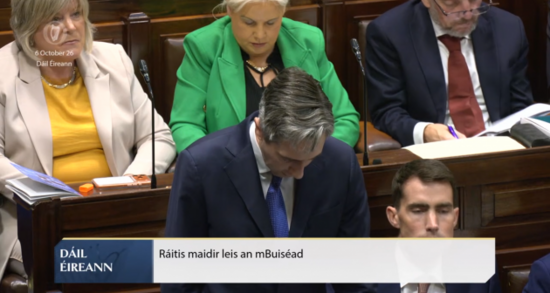
At 1pm, Minister for Finance Simon Harris will take to the Dáil floor to announce the details of Budget 2026, followed by Minister for Public Expenditure Jack Chambers.
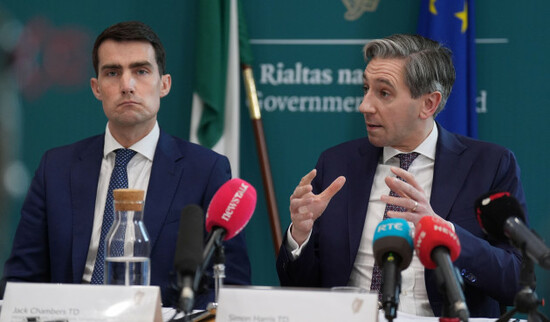
As we wait for 1pm, let’s chat about some of the changes in this budget that we already know about.
The main change that will directly affect pay cheques – albeit only by a few hundred a year – is an increase to the entry band for the higher rate of income tax.
Instead of the current €44,000 entry threshold for paying the higher rate of 40% income tax, the new entry point will sit at €46,500.
No change is expected to the USC.
Currently, a child can inherit up to €400,000 from their parents in their lifetime before capital acquisitions tax of 33% kicks in.
We’re expecting the budget to increase this threshold to €420,000.
The threshold for siblings, nieces, nephews and some other relatives will increase from €40,000 to €44,000, and for non-relatives, it’ll increase from €20,000 to €22,000.

On the housing side of things, the Help to Buy tax rebate limit for first-time buyers is set to increase from €30,000 to €35,000.
However, changes that were mooted for stamp duty for first-time buyers have been scrapped.
For households that rent our a room in their house, the rent-a-room tax-free allowance is set to increase from €14,000 to €16,000.
The rent tax credit for renters is increasing from €1,000 to €1,150 for a single person and €2,300 for a couple.
Taoiseach Micheál Martin was promptly posting on social media at 8am this morning to say that this will be a budget for families and for workers.
“We’re endeavouring to ease the pressures, because there’s no doubt that cost of living is a significant factor for all of you today,” he said in an 80-second clip.
“The government cannot sort out every issue, but at least we can make substantial efforts to reduce that pressure on families, and today’s budget will do that.”
This is a Budget for families, for workers and helping people with rising costs. - We're putting more money back in workers’ pockets - Supporting families and carers with the cost of childcare and disability - Easing the burden of fuel and energy costs for those who need it most https://t.co/Cj4UGysE5V
— Micheál Martin (@MichealMartinTD) October 6, 2026
Recipients of the State pension and core social welfare payments will see the rate of payments increase by €10 per week.
The customary Christmas bonus will be paid again this year to those in receipt of social welfare payments.
There’ll be no increase to the Children’s Allowance in this budget, but there will be an additional €6 per week for the child support payment.
A permanent disability payment of €500 has also been agreed for the first time.
There will also be a €5 increase per week to the fuel allowance.
Want a full rundown of everything we know about what to expect from the budget?
Here’s a round-up of our reporting on what’s anticipated.

The Dáil chamber is filling up as politicians take their seats for the much-anticipated budget announcement.
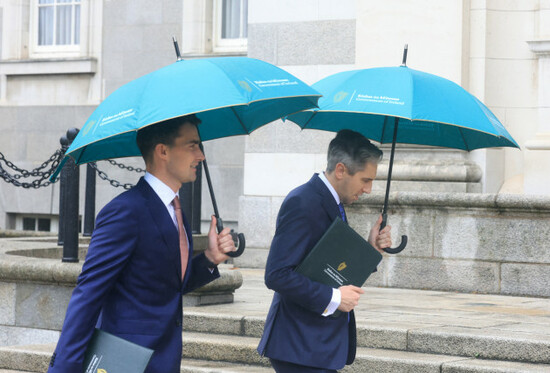
Harris and Chambers entered the building earlier sporting Government-branded umbrellas. You can insert your own jokes here about rainy day funds etc etc.
Our politics editor Christina Finn is in the Dáil chamber for the budget announcement.
She tells us that the budget documents are being handed out now to politicians, who are eagerly pouring over them, and says it’s notable that Michael Healy-Rae is seated up in the back, far from the government benches where he was last year when he was agriculture minister.
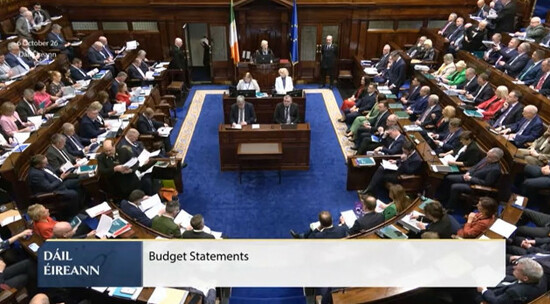
After a preamble about cost of living pressures and economic volatility, we’re getting into the meat of things now.
Harris has confirmed the government’s decision to raise the entry point for the higher rate of tax from €44,000 to €46,500.
Personal, employee and employer tax credits will each increase by €125, and the home carer tax credit will increase by €100.
The entry threshold for the USC 3% band is increasing by €1,600 from €28,700 to €30,300.
The thresholds for capital acquisition tax, which applies to gifts and inheritances, are increasing for the first time since 2024.
The amount a child can inherit without paying the tax is rising from €400,000 to €420,000.
The threshold for siblings, nieces, nephews and some other relatives will increase from €40,000 to €44,000, and for non-relatives, it’ll increase from €20,000 to €22,000.
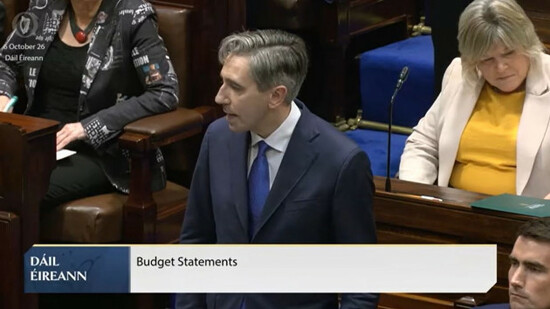
Harris said that for new State savings accounts, there will be a tax-free threshold of €50,000, a flat tax of 1% on the value of the account above that threshold, and a maximum contribution limit of €12,000 per year, with no minimum contribution.
In a significant change to carbon tax policy, Harris has confirmed that carbon tax on home heating oil and gas is being reduced and will “not increase again for the lifetime of this government”.
The rate of carbon tax on kerosene and natural gas were scheduled to increase today and again in May 2027 to reach €78.50 per tonne in line with planned increases to the tax, but instead will be reduced back to 2023 levels of €48.50 per tonne and remain at that rate.
The temporary reduced fuel excise rates that are currently in place until November are being extended until February 2027.
The childcare services relief tax exemption will increase from €15,000 to €20,000 to try to “increase supply and to remove the limit on the number of children that can be minded under the relief” in order to provide “greater flexibility to childminders to support the needs of parents and families”, Harris said.
He added that Chambers will make further announcements in relation to childcare costs in his speech later this afternoon.
Here’s what Harris has announced in the housing sector:
Among measures aimed at supporting the cultural sector, Harris announced an allocation of €15 million “to help keep our pub doors open”.
And now, Harris moves on to where the government’s going to get the money to fund all of that.
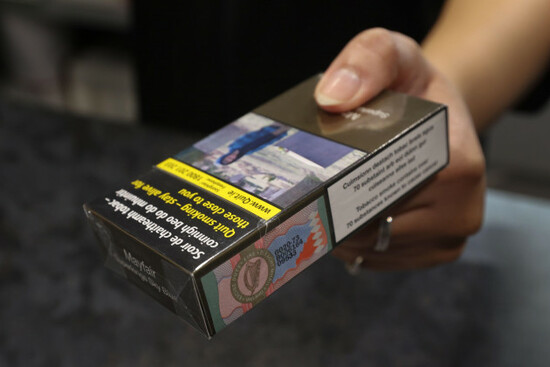
One way is through an increase to the excise duty on a pack of 20 cigarettes by an additional €1, with pro rata increases on other tobacco products as well.
The duty on e-liquid products if increasing by 20 cent per millilitre.
Harris wraps up his speech by saying that the government is responding to uncertainties in energy markets, global bond markets and geopolitical relations by “building up our national resilience”, “by anchoring our tax policy” and “by using the resources of this state to improve and expand critical infrastructure”.
Jack Chambers is up next as public expenditure minister.
The Journal’s annual budget calculator is live now.
You can use the calculator to figure out what the tax changes in the budget will mean for you.
Chambers kicks off his speech by saying that Budget 2027 is coming from a “position of strength”.
But he goes on to say that the concentration of corporate tax receipts among a relatively small number of firms is a “significant vulnerability” for Ireland’s public finances – and in that vein, current expenditure growth next year will be brought down to 6% from over 8% in recent years.
“This will see an extra €7.1 billion allocated in 2027, bringing the total level of gross public expenditure to €125.6 billion,” Chambers said.
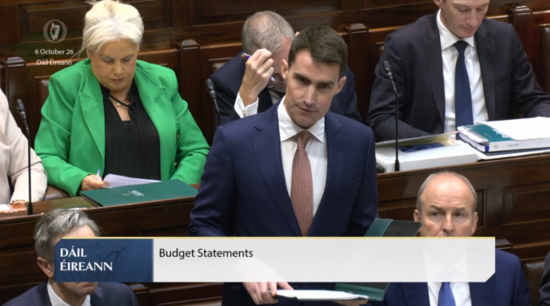
Through the National Development Plan, €4.2 billion will be allocated for additional investment in projects like Dart Plus, BusConnects and the Cork area commuter rail programmes, as well as road projects like the Galway Ring Road and the M28 Cork to Ringaskiddy.
The government is also allocating an additional €6 billion from 2027 to 2030 to make progress on MetroLink.
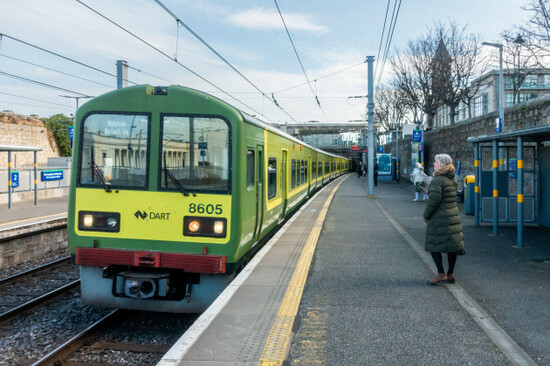
An allocation of €3 billion will be put towards delivering social housing, including 11,250 new-build social homes, while over €1 billion will be allocated to deliver “thousands of starter homes” through affordability supports alongside the Help to Buy scheme, Chambers said.
Chambers confirmed a range of changes to social welfare payments:
For children up to senior infants, the maximum childcare fees paid by parents is being reduced from €735 per month to €550 per month.
At third level, the student contribution fee for higher education is being reduced by €150 and the SUSI maintenance grants are being increased by 4.5% from January.
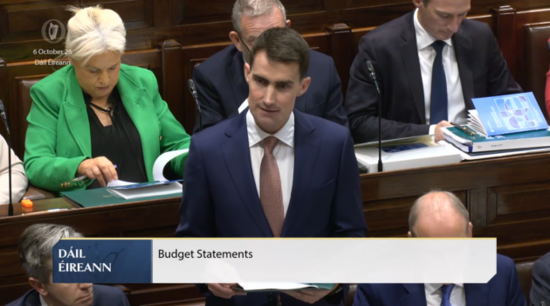
The Department of Health will be getting an additional €1.6 billion in current expenditure in 2027 to provide for an increase in the HSE pay budget for growing its frontline and community workforce.
There’ll be funding for an additional 1.8 million home support hours, for reform of GP services and better access to out-of-hours GP services, and for better access to dental and orthodontic care for children.
Eligibility for free contraception scheme will be increased to include 36 and 37-year-olds.
Chambers announced a package of €1.6 billion for the Department of Defence for 2027, an increase of almost 9%.
It will support an intake of 850 new permanent defence force members next year.
It will also go towards increases for Air Corps and naval service equipment, national preparedness and resilience funding, IT investment for digital transformation and the Joint Cyber Operations Unit, and healthcare and medical services for the defence forces.
€340 million under the NDP will fund new helicopters and the military radar programme, as well as investment in maritime surveillance and cybersecurity and modernising military installations around the country.
In sport, nearly €22 million will be put towards supporting Ireland’s hosting of the 2027 Ryder Cup and preparations for the 2028 European Football Championship.
The budget comes right as public sector workers plan industrial action days in protest over a lack of new public sector pay deal.
Just before ending his speech, Chambers said that he has made “significant provision in today’s Budget package for public service pay”, without specifying a headline figure.
“This demonstrates my seriousness, and indeed the seriousness of the government, in our desire to reach a new agreement that responds to the issues that have been raised,” he said, calling on unions to stand down from industrial action.
With the budget announcement speeches over, it’s time for the opposition to have their say.
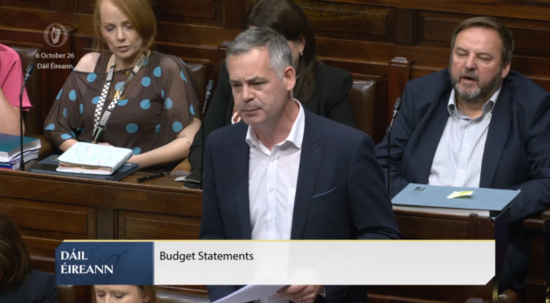
Sinn Féin finance spokesperson Pearse Doherty is up first, and as you might guess, he’s not impressed with the budget. He takes particular umbrage with the changes to the carbon tax, saying that Sinn Féin thinks the government should instead have scrapped it altogether.
Want to get more detail on some of the changes?
Catch up with The Journal’s coverage:
As the dust settles after the budget announcement, various ministers will be taking turns in the hot seat at the government press centre in Leinster House this afternoon.
Our reporter Emma Hicky is there now for Minister for Social Protection Dara Calleary briefing media on the changes to social protection in the budget.
Calleary said a total of €30 billion will be invested by his department next year, an increase of €2 billion on last year.
“We have over 3.5 million beneficiaries of regular weekly, monthly payments and supports,” he said. “A quarter of these are pensioners. 1.2 million of those are children.”
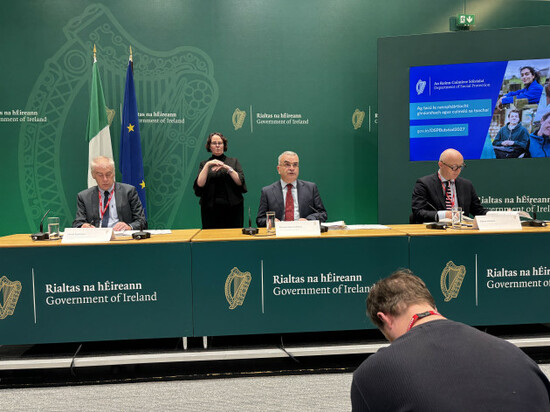
He said jobseeker payments account for less than 10% of his department’s budget.
On the new disability payment, he said that his department sought input from disabled people when assessing what form the payment should take. He said the clear consensus is that the payment should be designed based off the recipients’ views.
“That process is taking time, more than I anticipated, but I want to try and work with people in as far as I can.”
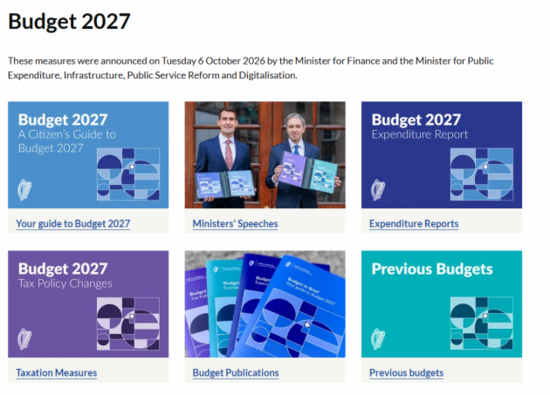
If you’re a real politics and/or budget nerd, you may enjoy a sift through the official budget documents, which includes the ministers’ speeches and various reports on tax and expenditure.
(Or, you can get a quick overview of the main changes here on The Journal.)
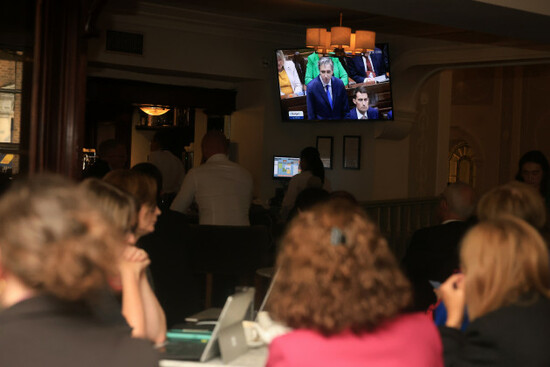
Across the road from Leinster House, here’s how things looked in Buswells Hotel this afternoon as pundits tuned in to the budget.
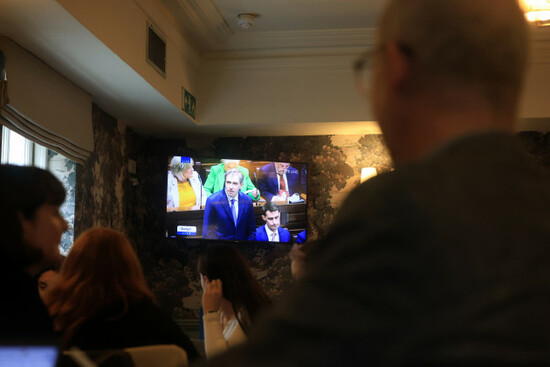
In the Dáil chamber, opposition politicians are still reacting to the budget announcements. Labour TD Ged Nash has just labelled Harris and Chambers as “Soundbite Simon and JackGPT”.
Earlier, Social Democrats TD Cian O’Callaghan said the budget is lacking in “new ideas”.
“What we got was tinkering around the edges, nothing substantive to address the key issue that households are facing: that electricity bills, which are already the highest in Europe, are continuing to skyrocket, that more than half a million households are in arrears in their energy bills, and individuals and families all across the country are facing into a bleak and cold winter,” O’Callaghan said.
Ged Nash of the Labour Party has passed the baton to his parliamentary colleague Marie Sherlock to air their party’s grievances with the budget.
Nash said it is “extraordinary that we’ve got rising levels of child poverty at a time when this country was never richer”.
Taking to her feet, Sherlock then said she finds it “very disrespectful” that no cabinet minister remained in the chamber to listen to the opposition’s concerns.
“Minister Dillon, you must have pulled the short straw today,” she told Fine Gael Minister of State Alan Dillon.
Our Political Correspondent Jane Matthews has some analysis available on the budget.
She writes that the government has sought to remedy last year’s mistakes by promising a small bit of everything to almost everyone in today’s budget.
Green Party leader Roderic O’Gorman is now addressing the chamber.
O’Gorman hit out at what he said is a lack of action on addressing the energy crisis. He said that “every major budget decision” should have been taken to help people reduce their dependence on fossil fuels.
“What has been announced this afternoon points towards a government that doesn’t see and doesn’t understand the impact that the cost of energy crisis for large parts of our society,” he said.
O’Gorman said targeted energy credits are the “most effective way of providing immediate support to those who are desperately struggling, as well as to those in the squeezed middle”.
Similarly, the Green Party said the minute increase to SEAI funding (2%) to provide for retrofitting was not sufficient.
Earlier in the week, there was a sense of some drama brewing as Culture Minister Patrick O’Donovan’s €100 culture card idea appeared to have been shot down by the man holding the purse strings, Minister for Public Expenditure Jack Chamber.
It’s understood the two clashed over the proposal, with some reports that O’Donovan walked out of a meeting following a heated discussion.
Some sources said they wouldn’t describe it as a walkout but that the arts minister was told his budget allocation request was “too high” and therefore there was no real basis for any further discussion on the voucher matter.
It is understood O’Donovan was asked to resubmit his idea with a reduced price tag.
But the culture card was nowhere to be seen when measures were announced this afternoon.
Chambers today told The Journal he wouldn’t get “into the details of private engagements and discussions”. He said all ministers present a level of spend that isn’t achievable.
“This measure isn’t something that we can fund in 2027,” he said.
In other politically-adjacent news, Gerry Adams has celebrated his 78th birthday.
The former Sinn Féin leader was serenaded as Gaeilge as he was presented with an unassuming cake bearing two candles.
At least someone’s having a good day.
Lá breithe sona domh 🥳 https://t.co/imEmAcBAxD
— Gerry Adams (@GerryAdamsSF) October 6, 2026
At the end of the day, the main question everyone has is: How will the budget affect me?
We’ve worked out how the key tax changes will impact different income brackets.
If you earn €30,000, €45,000, €60,000 or €90,000, you can check out here on The Journal how the budget will influence your take-home pay.

A new measure in this year’s budget is the first “cost of disability payment”, writes assistant news editor Valerie Flynn, who attended Minister for Disability Norma Foley’s press conference at Government Buildings this afternoon.
This will be a payment of €500 to 240,000 people who are in receipt of a long-term disability payment.
Reacting this afternoon, the Disability Federation of Ireland, which campaigned for the measure, said the amount in question would cover less than 5% of the extra costs disabled people face. It had argued for a payment of €55 per week, six or seven times higher than what was announced.
However, the NGO, which campaigns for equal participation in society for disabled people, welcomed what it described as the “first formal recognition of the extra cost of disability” as a “hard-won principle” after 20 years of campaigning.
Foley was asked about criticism of the new payment at the press conference at Government Buildings.
Foley said she felt it was “really, really important” that the new payment was included in the budget.
“I see this budget as a beginning, as establishing a principle of a cost of disability payment,” Foley said.
“There will be other budgets, in this particular government there will be three budgets, and I assume that will be built upon,” Foley said.
Conor McAuley, a disability advocate, said this afternoon that there are things he has to pay for that other people don’t have to think about, and times when he has to go without things that would make his life easier because he can’t afford them.
“This payment recognises that reality, but less than €10 a week will not change it for people like me. The costs we face are much greater than this payment can cover,” he said.
The budget announcement today has prompted a series of claims from opposition TDs about what the government did or didn’t do. Are they right? Our FactCheck team took a look.
The press conferences have been coming fast and hot. No fewer than five ministers turned up for the joint conferences for energy and transport, led by Minister Darragh O’Brien, who insisted that the reduction and freeze in the carbon tax on home heating oil and gas won’t affect progress on measures that the tax is used to support.
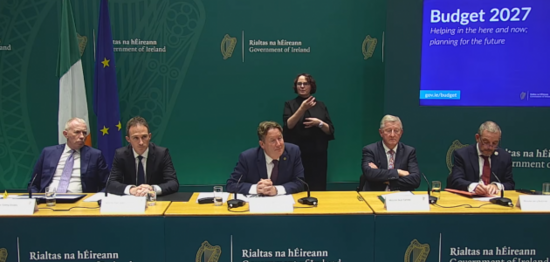
Funding from the carbon tax has been used for climate action measures like retrofitting supports for homes and businesses and helping farmers to move towards more sustainable practices.
O’Brien was questioned this afternoon over whether the reduction in the tax will translate into a hit to the funding for those measures – but he claimed that it will not.
He said the government is “not going to reduce our ambition or our output” in terms of plans like retrofitting. He said this year’s target of retrofitting 78,000 houses is on track to be met, and that he hopes to increase that to 100,000 next year.
The minister was also pushed on whether the U-turn on carbon tax undermines the government’s commitment to it as a climate action measure, and whether the move has created a weakness for the government – what’s to stop future fuel protests, for instance, demanding further decreases in the tax, now that the government has moved from its original position of increasing the tax over time?
O’Brien said he “respectfully disagreed” with that premise, and that the government is “committed to the carbon tax”.
We’ve talked a lot about what the budget means for workers – but how about students?
Our reporter Mairead Maguire breaks it down:
If you’re looking to sink your teeth into a little more budget coverage and analysis tonight:

To embed this post, copy the code below on your site




















have your say